Mallorca is nicer than you think! Don’t let stories of drunken hooligans romping around Magaluf put you off, this is actually a very beautiful and diverse island with something for everyone and it’s well worth a visit. Spain’s largest island covers an area of 3,640 km² and has beautiful sandy beaches, fantastic hill walking, stunning walled cities and the jewel in the crown, Palma de Mallorca – capital city of both the island of Mallorca and of the Balearic Islands. It also has lots and lots of people and, in the capital at least, a frenetic and vibrant energy which is interesting for an island once known as Isla de la Calma (Island of calm).


I took a morning flight into Palma de Mallorca on a little Iberia plane from Ibiza. The first thing you notice when you get off the plane is the sheer volume of people. This is one busy airport! You soon discover that it isn’t just the airport that’s busy – in Palma there are lots of people everywhere you go! Mallorca is Spain’s second most populated island (after Tenerife) and, with approximately 860,000 inhabitants, the fourth most populated in the Mediterranean. More than half of this number live in the capital and the island is home to many ex-patriate residents including a high number of Brits, Germans and Scandinavians.


The island takes its name from the latin ‘insula maior‘ – big island – previously known as ‘Maiorica‘ to distinguish it from its neighbouring island ‘insula minor‘ or Minorica – little island – now known as Menorca. There is often confusion about the present day spelling of the island’s name – should it be Mallorca or Majorca? One derives from Catalan, the other from Castellano – the two official Spanish languages of the island. It actually makes little difference as the ‘j’ and the ‘ll’ are both pronounced similarly as a ‘y’ sound in English.


I squeezed my way onto the airport shuttle bus (€5) without really understanding where it (or I) was going. I tracked my progress around the city on my phone with googlemaps (God bless technology) ready to jump off if it looked like it was going the wrong way. I was surprised and delighted when the packed bus continued its journey alongside Palma’s enormous port and dropped me off almost directly outside my accommodation. Result! I had only 2 days in Mallorca so I decided to make the most of it and explore Palma for a day and then head north to the beach resort of Port d’Alcúdia for the second day from where I would take the ferry over to Menorca. I hoped this would give me as broad a view of the island as was possible in such a short time. It was nowhere near enough.


I had booked budget as usual but this place (Hostal Terramar booking.com £40 – you have been warned!) was, without doubt, the worse place I have stayed in a very long time! After having been given a key to a room full of someone else’s stuff including bicycle, they gave me another one which was at least empty of other occupants and clean. The bed was comfortable and the location was great – everything else was dire. The (shared) bathroom had no glass in the window and my neighbour and I enjoyed uninterrupted views into each other’s rooms due to the curtains that were too small for the windows! Call me old-fashioned but I do like a hotel room window/patio door that closes and, preferably, locks – especially when it gives onto a patio with a wall to the outside world. Luckily I was only here for one night so I jammed a chair under the window handle and went out to explore Palma.
Palma has a serious port, packed with thousands of yachts and boats of all shapes and sizes. A wide and well looked-after promenade runs alongside the water with a state-of-the-art cycle highway running all the way into the city centre. A busy dual carriageway separates the waterfront from the hundreds of bars, restaurants and hotels which line this busy road. Buses run into town but it’s a lovely walk and there are plenty of bars with terraces on the way if you need to take a break. The walk was only about a 20 minute gentle stroll from my luxury accommodation.


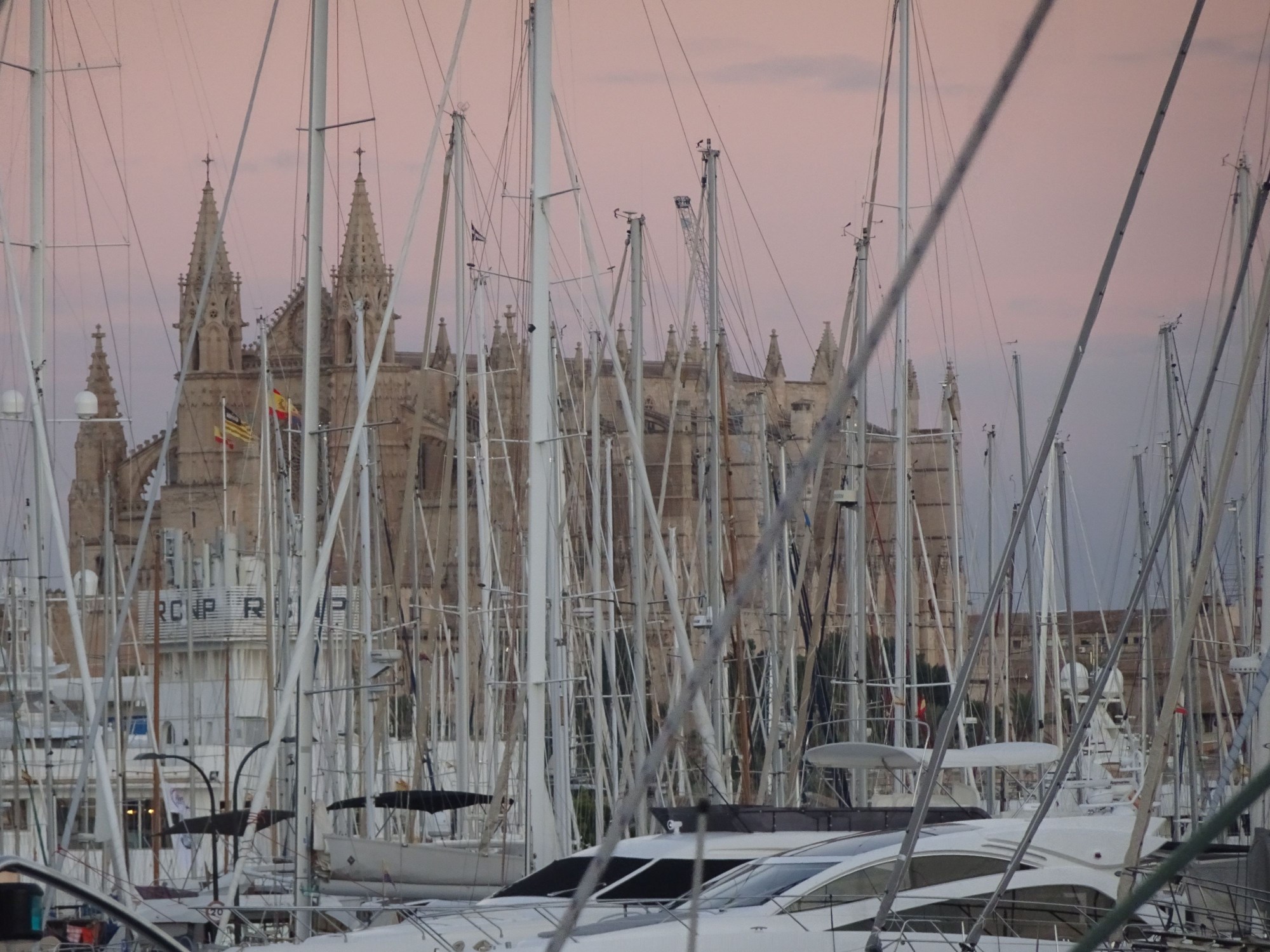
Palma’s cathedral or, to give it its official title, La Catedral-Basílica de Santa María de Palma de Mallorca is a wonder to behold and can be seen from anywhere along the port – so huge is it. Known in mallorquín (the Catalan dialect spoken here) as La Seu, it is Mallorca’s principle religious building. Built in the Levantine Gothic style it rises majestically into the sky from the shoreline of the bay of Palma where the city meets the sea. It has one of the world’s largest and most impressive rose windows, known as ‘the Gothic Eye’. The altar stone was consecrated in 1230 shortly after the Christian conquest of Madina Mayurqa (the arabic name for the city now known as Palma) from the Moors. The construction of the building we see today began in 1276 during the reign of King Jaime II. It has been added to and improved over the centuries and has its own very interesting website (www.catedraldemallorca.org) in several languages for those of you who are interested in knowing more. The sheer enormity of the dark and cavernous interior and the stunning stained glass windows are quite awe-inspiring (if tricky to photograph) – an absolute must-see for anyone visiting the city.


Apart from the volume of people, the other thing that is immediately noticeable in Palma is the enormous number of palm trees (‘palmera’ in Spanish). Huge and healthy palm trees line the streets around the cathedral and can be seen everywhere, blowing in the breeze.


Palma is a very walkable city and, in many ways, reminded me of other cities such as Paris or Barcelona. Its wide tree-lined avenues and pedestrianised areas are lined with benches, flower stalls and open-air cafés. Huge squares are decorated with statues and fountains. Narrow alleyways and steep stairways are reminiscent of Moorish times and the architecture is a fascinating mix of architectural styles.


Like any Spanish city, café culture is alive and well and tables and chairs are squeezed into any available space and are full, at all times of day and night, with locals and tourists alike. Ice cream is hugely popular here and there are lots of ice cream shops and kiosks all over the city. Tourists can be seen on benches and pavements everywhere eating ice cream cones and watching the buskers. There are some truly amazing guitarists busking randomly for a few euros in their hats.


Although there are lots of fascinating buildings to see in Palma, with limited time I had to be selective so, in addition to La Seu, I chose to visit the old Moorish hamam – the public baths. This is a delight! Situated down a quiet alleyway in the centre of town, the old hamam (what we would call ‘Turkish baths’) is an oasis of tranquility and has a beautiful little garden full of lush, green vegetation and bright tropical blooms where visitors can sit for a while and take a breather from the energetic city. The old buildings of the hamam are both beautiful and fascinating and the little museum is very well organised – well worth the €2.


Palma is the perfect ‘city break’ destination. It has everything – history, architecture, culture, an endless selection of bars, cafés and restaurants, a fabulous port, nearby beaches and countless palm trees – what’s not to love? I walked until I could walk no more, then drank cold beer in a harbourside bar and watched the fishermen and the kayakers emerge as the sun disappeared over the yachts, turning the sky a beautiful pink. I loved Palma. Stay in the town centre, pack comfortable shoes and prepare to be delighted.


The next morning I bade (a happy) farewell to my hostal and took the bus to the Plaça d’Espanya and the hub of all Palma’s transport, the impressive Estación Intermodal de Palma. Situated just in front of and partly below Palma’s enormous Parc de les Estacions, this compact station is the centre for all of Palma’s buses and trains to other parts of the island. Well-organised and modern, the main part of the station is situated underground and has bars, shops, loos and all the services you would expect from a central station.


I took the bus from here to Port d’Alcúdia on the north coast of the island. One of Mallorca’s main tourist attractions also leaves from here. The famous Tren de Soller is and old-fashoined narrow-gauge railway which operates on a route between Palma and Soller in the north west of the island, these days mainly just for tourists. It leaves from a cute little station (very reminiscent of a British country train station) right next door to the Estación Intermodal. Sadly, I wasn’t able to make the journey as tickets for the day I was in Palma were sold out.
The bus journey to Port d’Alcúdia took a little over an hour and mainly passed through rolling green hills and lush countryside, through the town of Alcúdia itself and finally down to the coast. Port d’Alcúdia is an experienced tourist town which has gone from being a small fishing port in the early 1960s to a bustling, family-friendly beach resort. The town clearly knows what is is doing to keep tourists happy – the 14 kilometer long expanse of wide, sandy beach with shallow water is well served by ‘chiringuitos’ (beach bar/restaurants), deckchairs, umbrellas and beach sports; the pedestrianised town centre set back from the boat-lined port area has restaurants for all tastes and there is a large childrens’ playground, supermarkets, cheap booze shops, taxis and lots of hotels all within an easy 5-10 walk of the centre. Excursion boats leave to other beaches or to watch dolphins from the main harbour.


I was here in October half term and it was quite busy enough. In August it must be tourist hell! A lady in a shop showed me old photographs of the town in the 1960s when only a handful of fishermen’s cottages lined the water’s edge, one of which belonged to her family and is now the shop we were in. She told me that in high season it is so crowded that tour buses queue to get into the town and even the tourists are asking where to go to escape the tourists! She also told me that whilst parts of Magaluf in the south are so overrun by drunken tourists that many Mallorcans would never go there for fear of having their cars overturned by tourists on drunken sprees, the north was more a place for family holidays and people returned there year after year. I could see why. It’s a great place for a family beach holiday. I headed to the beach for a beer in a chiringuito and treated myself to a sunlounger and an umbrella (which came complete with a combination lock box attached for your valuables). It was a fantastic sunny day and the beach was packed, mostly with Brits from the north east and their children! Happily they all disappeared early and left me to enjoy the fantastic views across the water to Menorca in peace!


Just before sunset I headed to the medieval walled city of Alcúdia for a wander around. Situated slightly inland from the coast Alcúdia is a beautifully preserved example of a walled town. Originally a Moorish farmstead, Alcúdia (‘on the hill’ in Arabic) was taken over in the Christian conquest of 1229 and later bought by King Jaime II in 1298 who built a new town on the site. The construction of the well-preserved walls began then and were finally finished in 1362. Today you can walk along the top of the walls around most of this compact and lovely little town for fantastic views down onto the well-swept and cared-for narrow streets, dotted with potted plants, and outwards in the other direction across the island and down onto an outdoor fitness class!


Tourists gather in the bars and restaurants of the old town centre’s candlelit squares and cobbled streets whilst the locals prefer the bars and terraces just outside the walls where the enormous square offers more space for the children to run around and play football whilst parents relax over a beer in one of the many bars. I bought local savoury pastries in a tiny shop and chatted to the owner about how similar they were to our Cornish pasties – the origins of both being apparently similar. She told me she’d been to Cornwall and had tried to make and sell British-style pasties but they never caught on with the locals who preferred their traditional recipes. I loved it here.


Meanwhile, back in Port d’Alcúdia, the tourists were wandering around eating ice creams or sitting in bars sipping drinks whilst their children – happy to be up this late – ran around or played in the public play area. No drunken revelry here. Just families having a nice, relaxed time in a peaceful little resort. My little hotel was fairly old and basic but great value and central and so much nicer than in Palma (Hotel Elegance Calma http://www.booking.com about £32 B+B – well worth booking a double even if you are single.)
Friendly and welcoming people, fabulous weather, beautiful scenery, amazing beaches, brilliant tourist infra-structure with history and culture in spades – I really enjoyed my whirlwind tour. Mallorca is definitely much nicer than you think (just don’t go in August!)
NEXT ISLAND: I will be sailing across the water to Menorca – last of the Balearics.
 53 islands!
Mallorca, Completely different to my expectations ! Thanks for a superb peep into a delightful world. Keep up the good work.
LikeLike