I chose Iceland as number 53 and the Grand Finale as I wanted to go somewhere a little bit different to the other islands I’d visited previously. I considered going outside of Europe but as the other 52 islands had all been in Europe, I decided to stay with the theme. Iceland turned out to be the perfect end to an amazing year.


I was accompanied on my trip by my friend of longest-standing, Debbie, who was very enthusiastic about our visit. We flew to Keflavik, Iceland’s airport, from London Luton, departing around 6 am on the final day of this challenge, 13th January 2018 – the day before my birthday. The flight takes a little under 3 hours. One of the strangest things about travelling to Iceland at this time of year (for those of us unused to drastic daylight changes) is that it doesn’t get light until around 11 am. On the day we arrived sunrise was at 10.59 so it was still very dark when we got off the plane at 9 am!
Iceland (pronounced ‘istlant’ in Icelandic) is a Nordic Island in the North Atlantic, situated between Norway, Greenland and the UK. The island covers an area of 103,000 km2 and is home to nearly 350,000 people, most of whom live in or around the capital city of Reykjavík. It is the most sparsely populated country in Europe. A volcanically and geologically active island, Iceland has a temperate climate despite its location just outside the Arctic Circle due to its proximity to the Gulf Stream. The interior of the island has lava fields, mountains, glaciers and geysers. It is famous for its natural hot springs and the world-famous Blue Lagoon.
According to ancient manuscripts, Iceland was first settled by a Norwegian chieftain in 874 AD. It remained independent until it acceded to Norwegian rule in the 13th century and later joined the union of Scandiavian nations under the Kalmar Union established in 1397. In 1523 Iceland came under Danish rule and Lutheranism was forcefully introduced as the island’s religion in 1550. More recently, Iceland regained independence in 1918 and became a republic in 1944.
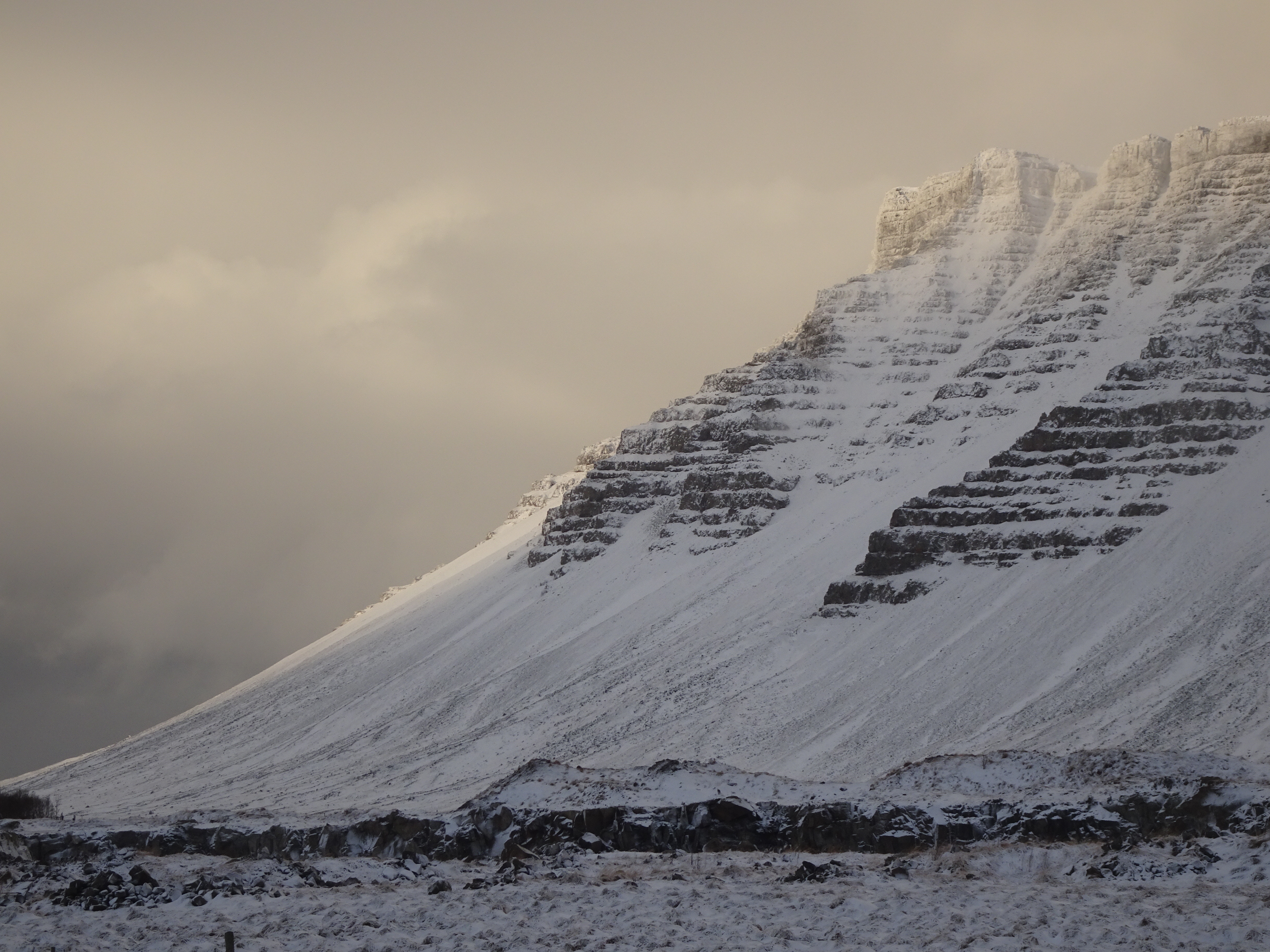
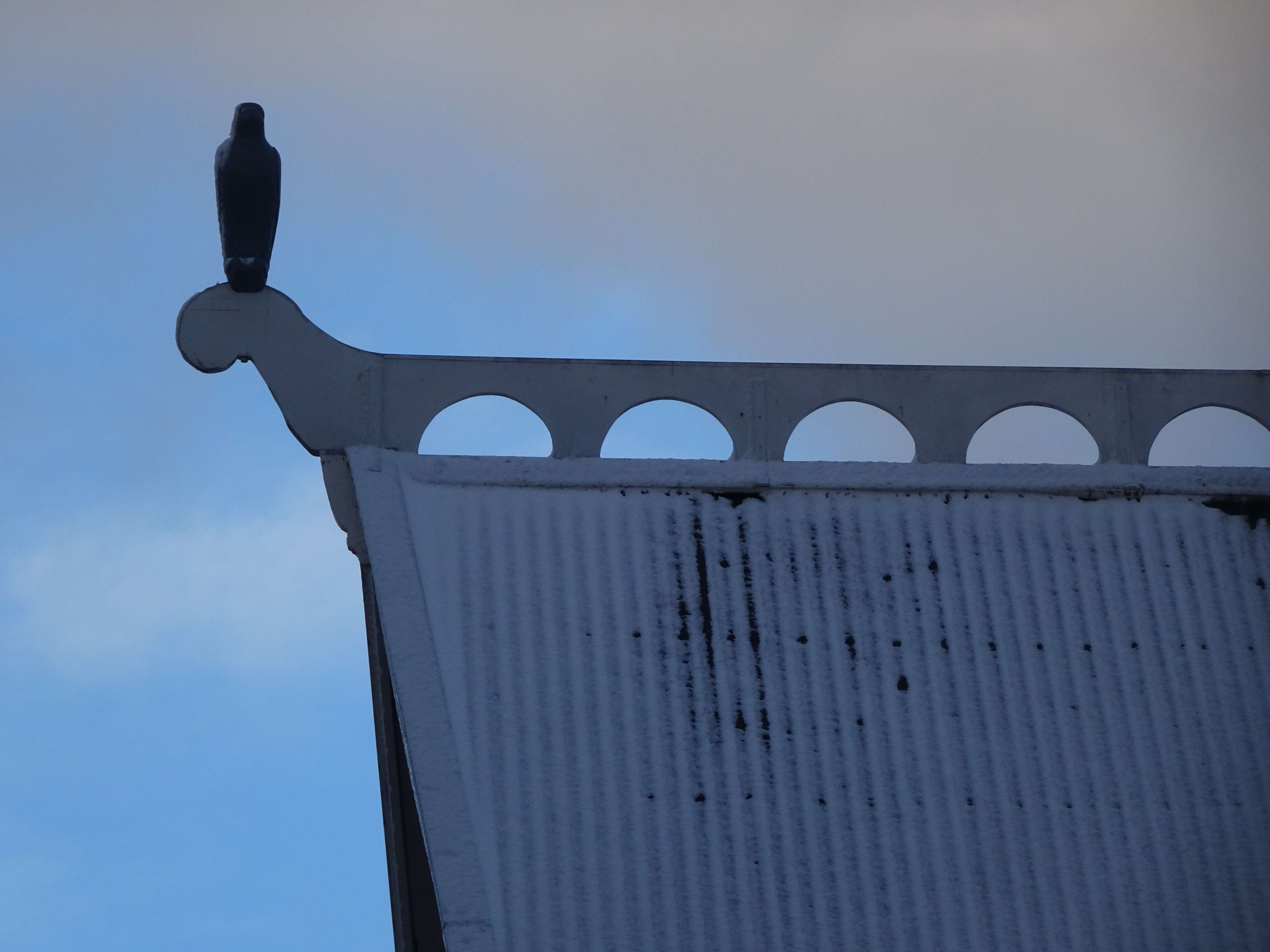
Until the 20th century, Iceland was one of the poorest countries in Europe but aid from the Marshall Plan following World War II and the industrialisation of the fisheries brought greater prosperity. In 1994 the island joined the Eurozone. Iceland’s parliament, the Althing (Alþingi), is the world’s oldest parliament with a system of proportional representation. Iceland rates number one in the Global Peace Index! It’s an impressive place! The economy was severely effected by the banking crash in 2008 and several people were jailed as a result but the island has managed to make a good recovery mainly due to an increase in tourism.
We picked up our hire car without any problems but outside the airport were welcomed by an icy cold, wet and dark morning with a horrible, horizontal sleet blowing across the car park. Panic ensued when we discovered that our car was automatic and I, the designated driver, didn’t know how to drive one! So it’s cold, dark and sleeting and I’m sitting on the left hand side of a car I don’t know how to drive! I considered going back inside and asking for a car with a gear stick but it was too cold and wet so we persevered. After a quick lesson from my (very patient) co-driver, I managed to get the hang of my redundant left foot and off we went. Luckily it was a fairly straight road from Keflavik to Reykjavík, Iceland’s capital, so I had some time to practice. Things improved once it got light!
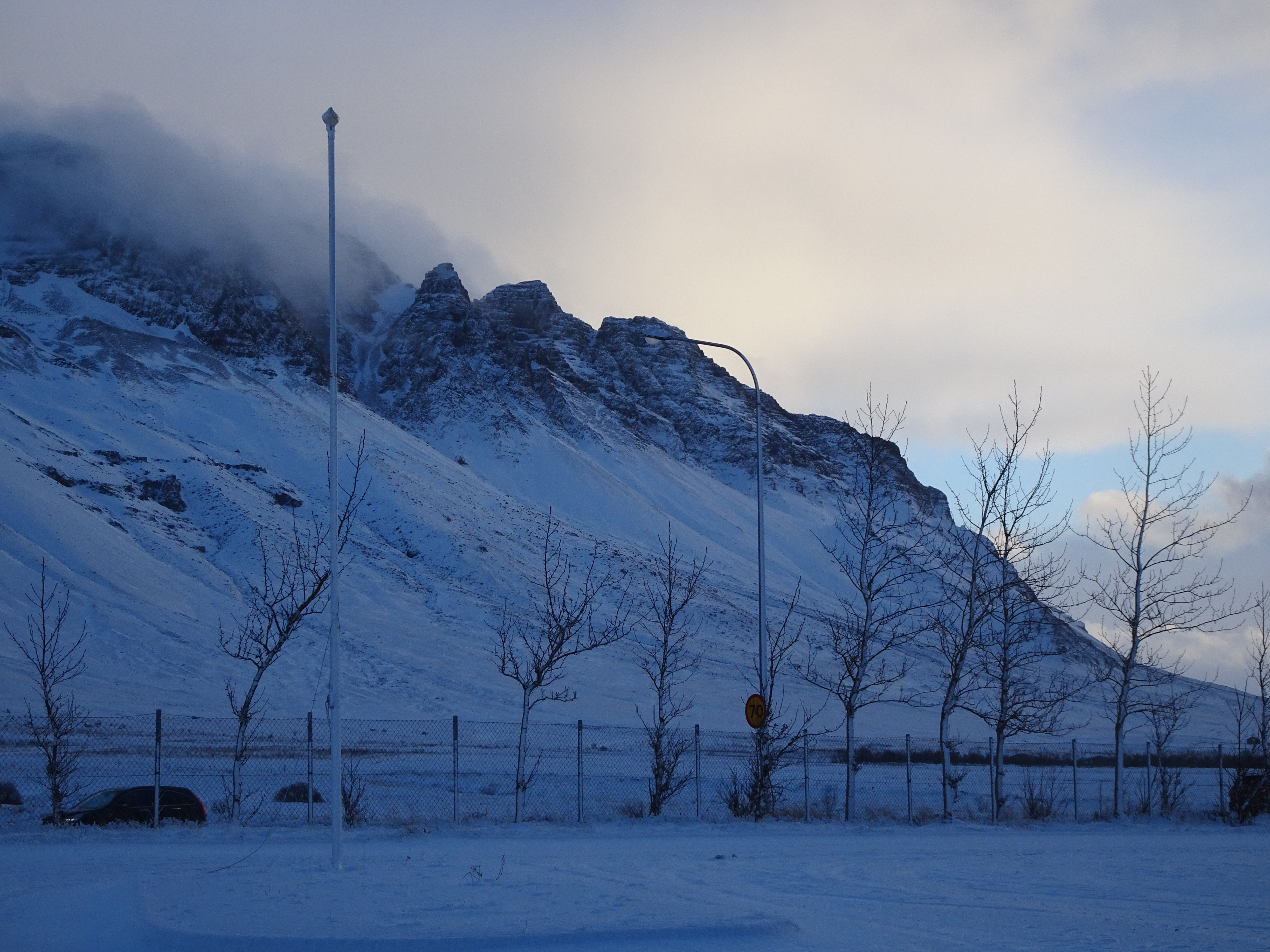


We had 3 days and 2 nights in Iceland and we had planned a busy itinerary to try and see as much of the island as possible. It turned out the weather had other ideas. I’d booked our first night in Borgarnes – a little town in Western Iceland – supposedly a great place to see the Northern Lights. On the plane we’d studied the map and the guidebook and planned a fairly busy schedule. By the time we reached Borgarnes, we’d changed our plans – it was to be a theme of the weekend. The weather was wet, grey and dull and – although we drove right past them – we could hardly see the mountains at the side of the road because of the low, thick grey cloud. We had planned to head further north to some of the harbour towns on the Snæfellsnes peninsular but, with such dismal weather we decided on a nice lunch and a soak in some hot water somewhere instead!
The drive to Borgarnes follows highway 1 along the coast from Reykjavik for most of the way – sea on one side, mountain on the other. On a clear day, it must be absolutely stunning but with such low cloud, it was almost impossible to see anything – all was grey like a black and white photograph. We passed through the 5,770 meter long Hvalfjörður toll Tunnel which runs 165 meters under the Hvalfjörður fjord and past the slopes of steep mountains. We continued past some tiny hamlets along the water’s edge and some clusters of short and sturdy Icelandic ponies. The journey ends by crossing the Borgarfjörður fjord on a causeway arriving at the junction for Borgarnes.


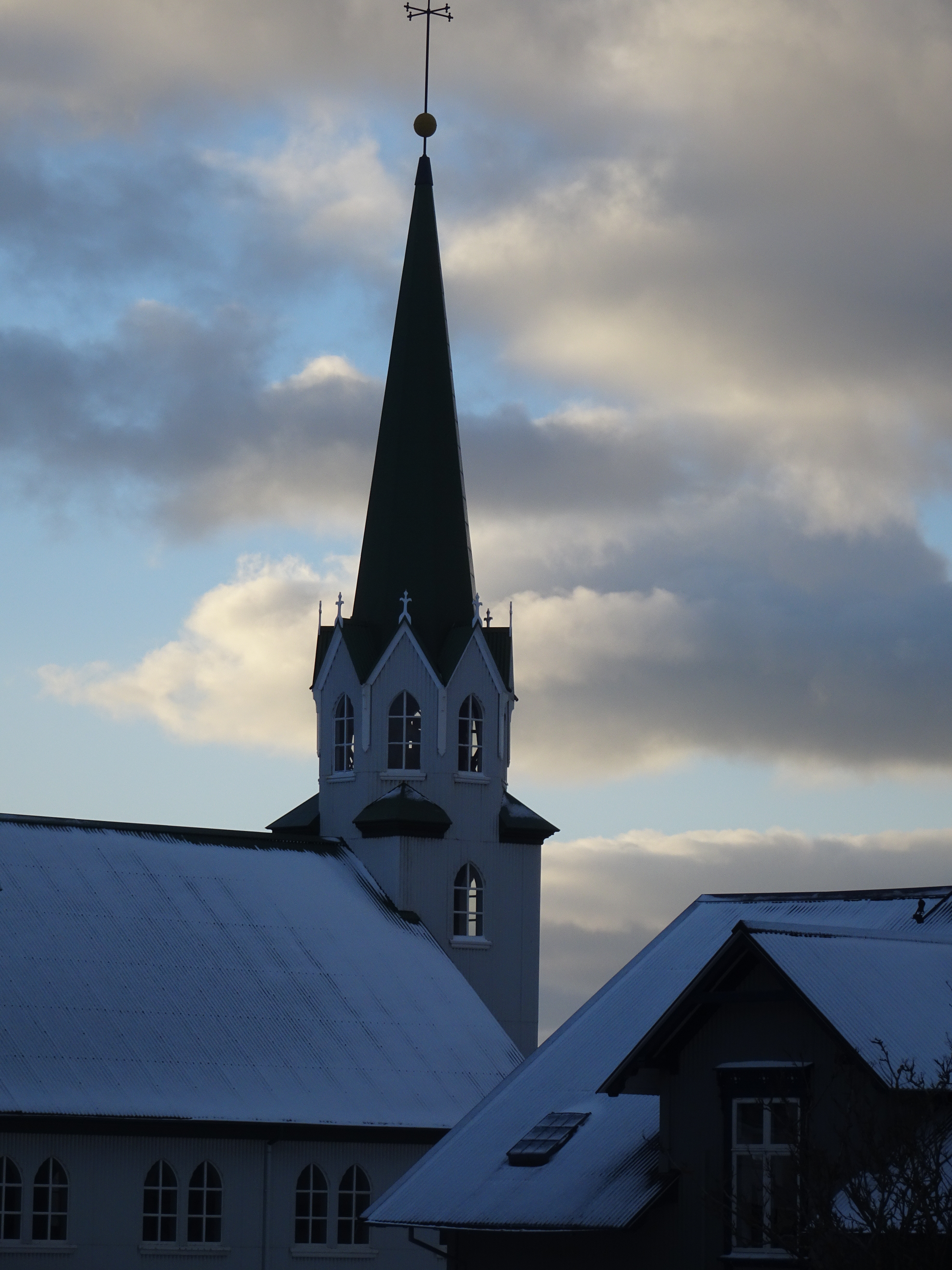
Our hotel, Icelandair Hotel Hamar, was a little bit out of town with a garden that led to the water’s edge and an outdoor hot tub which we were looking forward to using but, in the event, didn’t as the blizzard blowing outside wasn’t very enticing! We settled on a drive into Borgarnes for lunch and a swim at the local pool. Borgarnes is a small and fairly typical Icelandic town built on the water’s edge with an elegant church with a huge spire occupying the high ground and a few streets of corrugated metal houses. The town has a Settlement Centre built into the rock of the hillside with a museum, an exhibition of Iceland’s history, an interesting souvenir shop and a restaurant. We had a fabulous lunch of traditional Icelandic fish soup served in a huge tureen served with thick slices of delicious home-made bread and wonderful butter sprinkled with Icelandic black salt. We tried the local beer too – it was all delicious!
Iceland is a member of the European Union but has retained its own currency, the Icelandic Króna (or ISK for short). It’s not an easy exchange rate to remember. In the end, we worked out that 1,000 ISK was about £7, give or take a few króna. It doesn’t matter too much when you are there as Iceland has an almost cashless society. I didn’t see any cash money at all in the 3 days I was there. Everything can be paid for by card – even parking meters!
The weather was cold and wet and not nice enough to walk around in. We thought we’d check out the local swimming pool and, in particular the ‘hot pots’ or ‘heitar pottar’ we had heard so much about. The town’s municipal swimming baths weren’t much to look at but were very cheap and friendly. There is a very strict shower protocol before bathing in any public baths in Iceland. We read that it was very important to observe the rules or risk deeply offending the locals. We left our boots at the door and made our way into the changing rooms. Clothes are deposited in lockers in the dry area, towels can be taken and put in the special towel area in the next, wet, area. A thorough shower must be taken with soap before entering the water and before putting on your costume. In case you were in any doubt, a poster on the wall shows which parts of the body (including hair) must be thoroughly washed – with soap – before putting on your bathing suit and getting into the water. Not wishing to offend anyone, we observed the protocol and then, scrubbed clean and attired in our costumes, ventured outside to find the hot pots.
A big sign on the wall told us that the temperature was -1°C! The outdoor pool is heated to 28°C but the hot pots are warmer. There were 3 of them in all – a bit like oval-shaped, deep, rugby baths but with steps in from both sides, the hot pots had signs indicating the temperature of the water. We started in the first one – 36-38ºC said the sign. It was like a lovely big warm bath. We were delighted! The water is deep and there is a shelf around the edge to sit on. A friendly Icelandic lady with her children showed us how to press the buttons on the edge to activate the water jets – lovely! It got quite crowded whilst we were there as 2 friendly families with children joining us in the first ‘pot’. We ventured to the second one (38-40°C) and chatted to an equally friendly man with his 2 children who told us they came around 3 times a week. We skipped the third pot (40-42°) as we weren’t sure Deb’s blood pressure was up to it! We sat in the hot water for well over an hour before dashing back through the sub-zero air to the warmth of the changing rooms. Sadly there is no photographic evidence of this event!
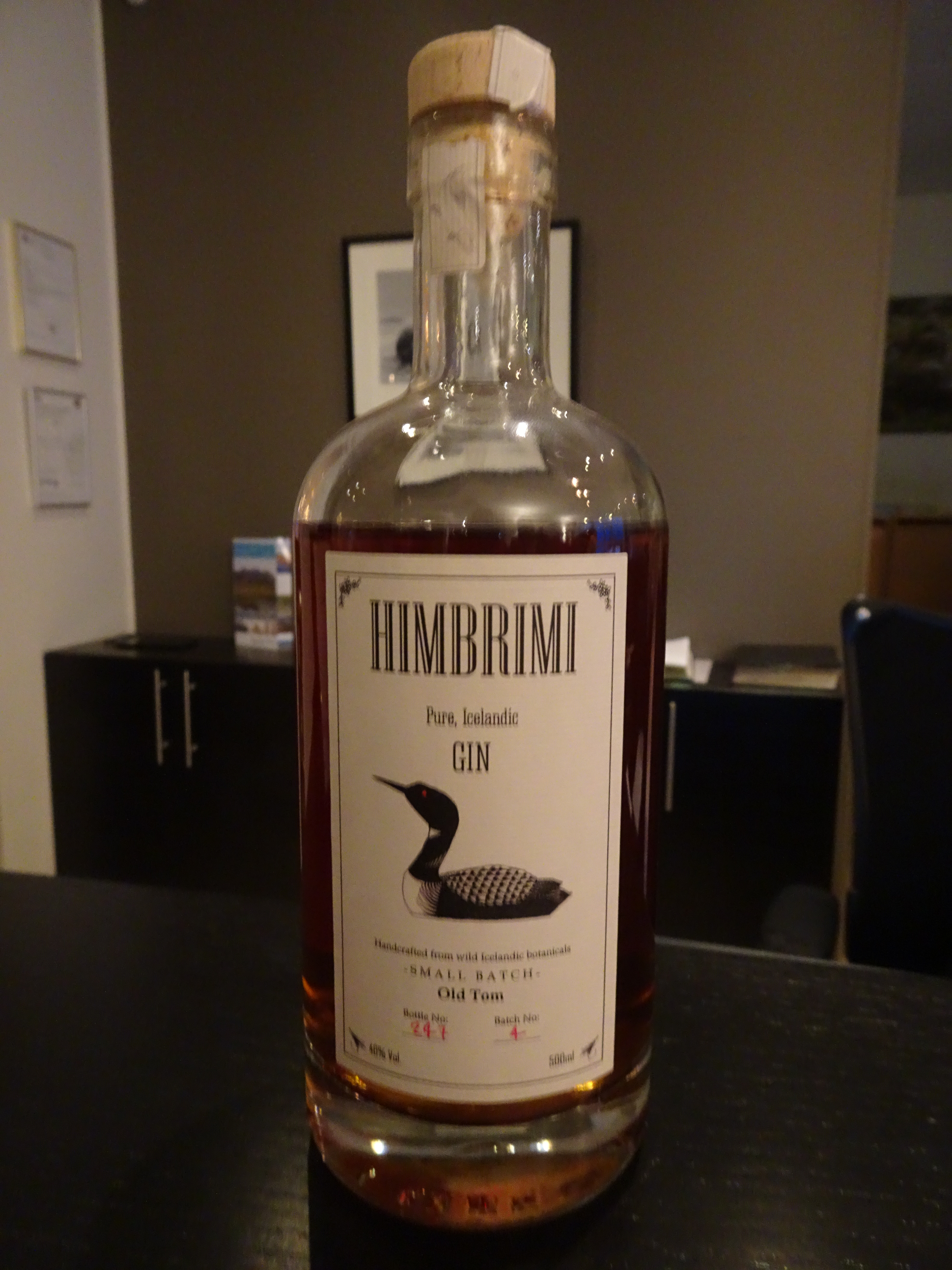
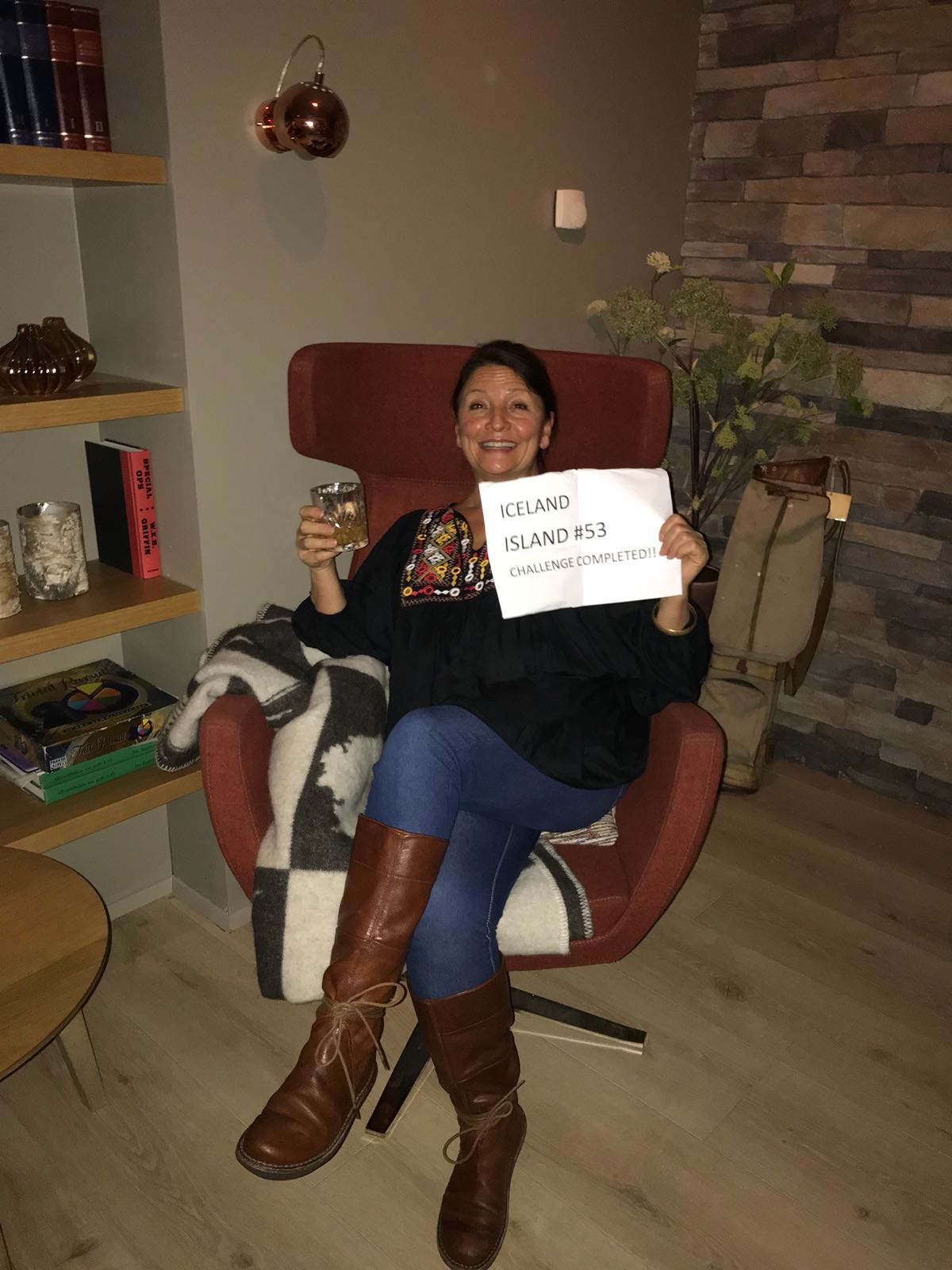
Back at the hotel, we had a (budget) bed picnic of snacks we’d brought from the supermarket and a bottle of duty free fizz and hit the hotel bar to celebrate completing 53 islands within the deadline! As we weren’t eating, we were invited to sit in the lounge. It was a lovely room – modern but cosy – with sofas and armchairs, furry cushions and some very nice icelandic blankets. Deb fell in love with the blankets! There were books and board games, huge photos of Iceland on the wall and a friendly waitress that recommended the Icelandic gin! The waitress told me that Himbrini was brown in colour, not clear like standard gin, and was drunk neat with ice. So that’s what I ordered. The best smelling drink I have ever tasted! It smelt delicious! I just sipped it and smelt it and made it last all evening. On our way to bed, the receptionist told us that the Northern Lights were very active. Unfortunately, there was so much cloud cover we couldn’t see them!! We slept with the curtains open just in case. The sky was very light but sadly the cloud cover didn’t clear.
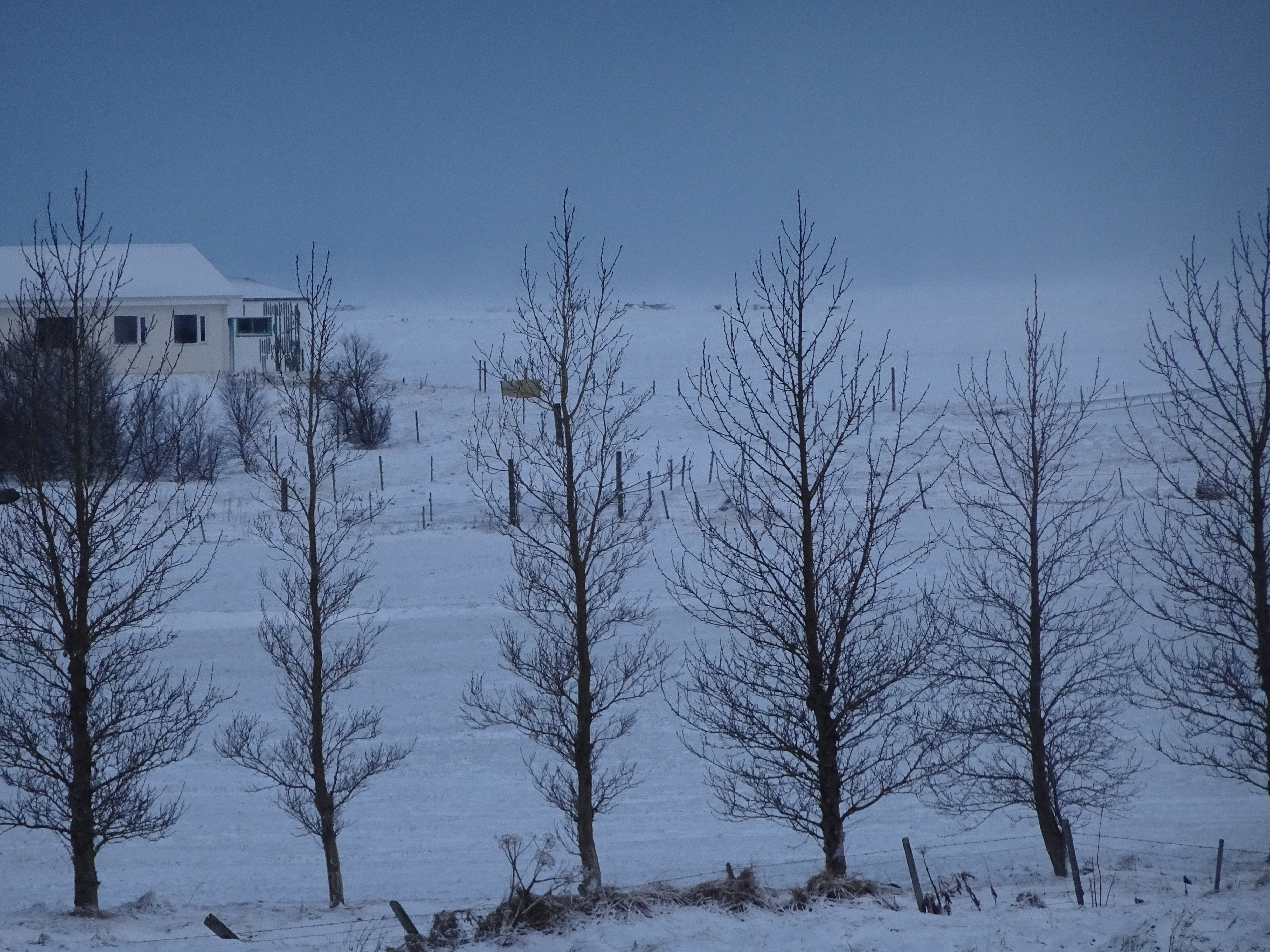
In the morning we awoke (in the pitch darkness) to a winter wonderland outside our window. It had snowed overnight – a lot!! Everything was covered in a deep blanket of thick white snow. The clouds were clearing and, as it got light outside, it started to look really beautiful with a sort of blue tinge to everything. Our car was encased in a couple of centimetres of ice and another couple of centimetres of snow on top of that! We were supposed to leave and stay the next night in Reykjavík but checked with the receptionist whether it was sensible to drive. She said the weather was some of the worst they ever have but the roads should be OK. As long as you stick to the main roads, she said, you’ll be fine! She warned us about the snow blowing down onto the road from the first mountain on the left!


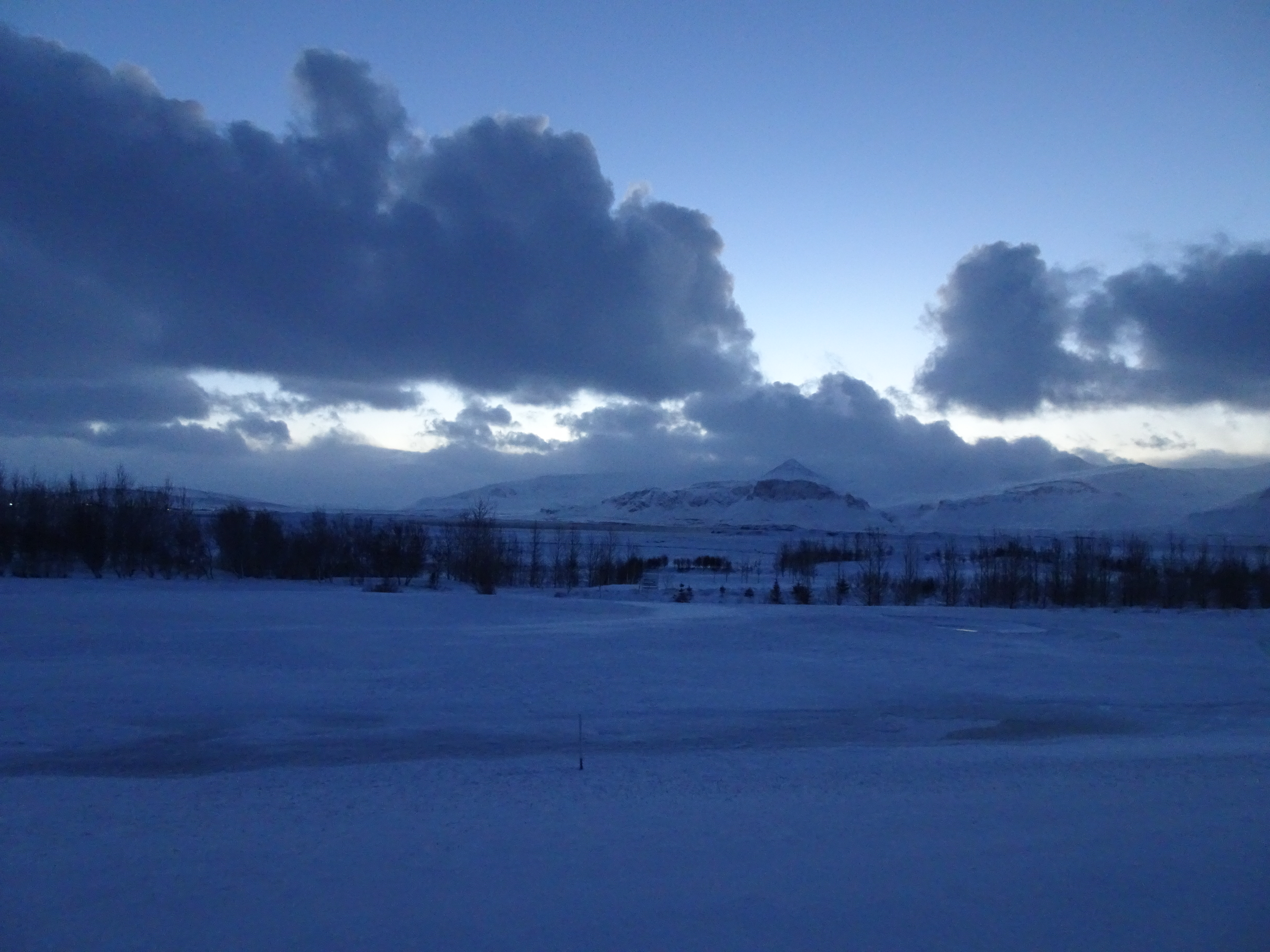
Luckily the hotel handyman had a wonderful scraper with a big brush on one end and an evil scraper at the other. I had to practically crack the ice around the car to get it off! It took about half an hour before we were ready to go! Deb sat in the car while I scraped as she said I looked as though I was enjoying myself!! We drove into Borgarnes for a look at it in the snow before leaving. The road was passable but there was still a lot of snow on it. Groups of Icelandic ponies huddled together in the fields on the way. It was very windy and very chilly and looked completely different to the day before. We took a few hurried pictures and headed back to the warmth of our car.


Everyone told us that hot dogs are one of THE things to eat in Iceland. Icelanders told us it’s a popular thing to eat at service stations so, before hitting the snowy road for Reykjavík, we tried one. It was quite small but tasty (nothing that would impress a German) and it came with nice crunchy onions and a selection of sauces. The bemused staff told us that Icelanders eat theirs with a combination of mustard, ketchup and a third sauce, remoulade, and so did we. It was delicious! Good food for the road!

The drive to Reykjavik was hair-raising! It started off well, the roads really are excellent, but then the snow started blowing down off of the mountain as the receptionist had warned us it would and we found ourselves driving into a total white-out snow blizzard. It wasn’t fun! Luckily my co-driver was calm and reassuring (she’d make a great driving instructor) and it was fine! Once we made it past the mountain, it was a beautifully scenic drive across flat fields covered in virgin snow with mountains looming up on either side and a blue glow everywhere. We stopped once at the roadside to admire the view and take some photos and once at a service station where we got stuck in the ice and had to be pushed out of a frozen puddle by two helpful men!


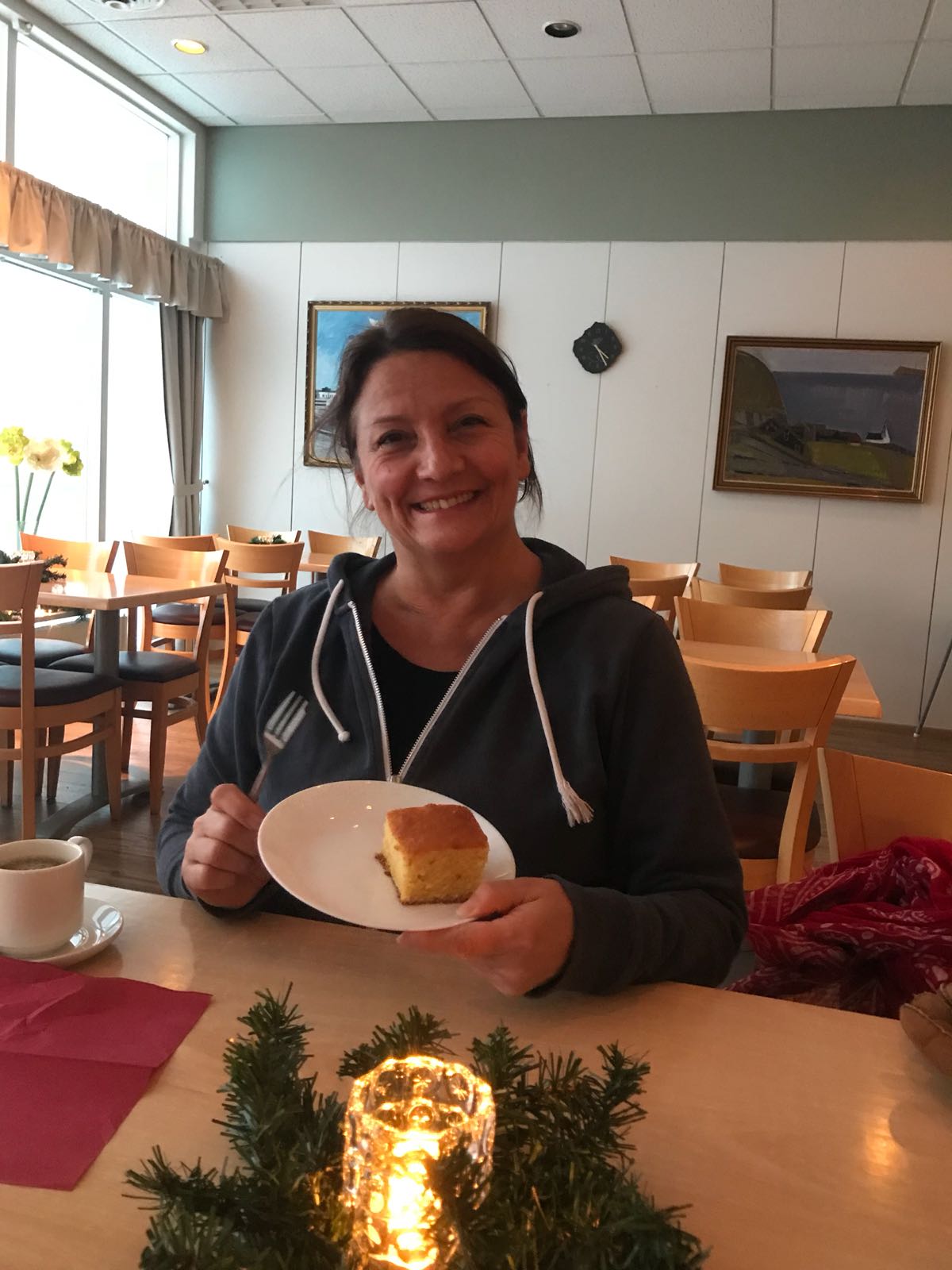
We arrived in Reykjavík where the snow was still thick on the ground even on the main roads, albeit a bit browner and sludgier than outside of town. We stayed at the Hotel Orkin, formerly a seaman’s mission for people from the Faroe Islands. The main reason I booked it was because it had a car park and offered free coffee and home-made cakes to residents! The staff were very friendly and helped us plan our journey by bus to the Blue Lagoon (I’d had enough of driving in the snow and didn’t fancy it in the dark!). We were surprised that the Blue Lagoon was so busy that we couldn’t get tickets until 6 pm that evening. We ventured out into the blizzard going on in the street in search of food but the recommended place was closed and we ended up at the only place we could find open – the (very nice) kebab and burger café across the road!


The lack of a bar, the function room doubling as a small church for retired seamen and Faroese people and the Salvation Army leaflets around the place suggested that alcohol consumption might not be encouraged in our hotel. We didn’t have a balcony so Deb surreptitiously buried our last bottle of Prosecco under the snow on the communal balcony to it would be nice and chilled by the time we got back from the Blue Lagoon!
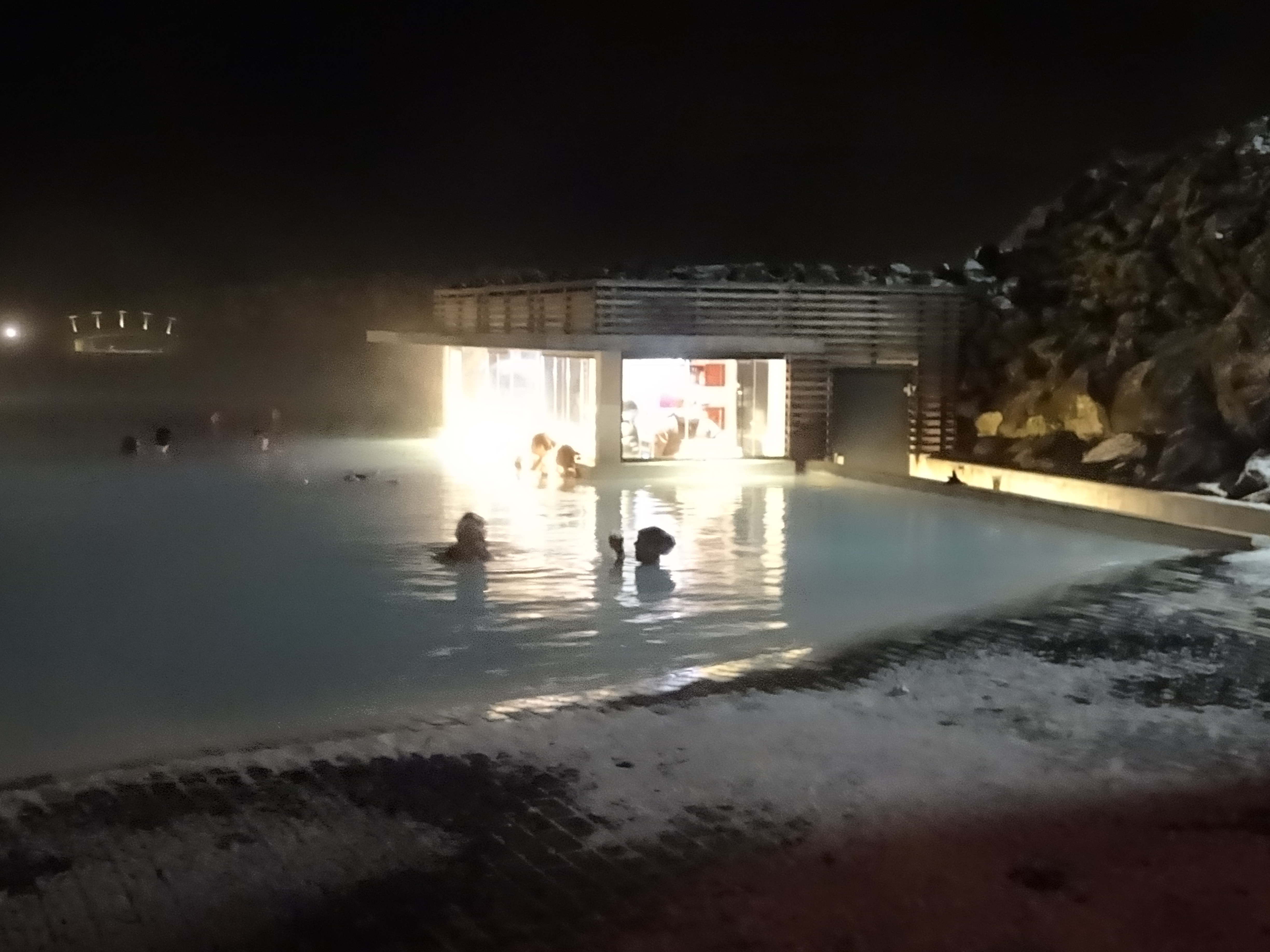
The Blue Lagoon is a definite must-see for visitors to Iceland in spite of the fact that it is now extremely commercialised. A little bus picked us up from the hotel and took us to the main bus station where we joined a larger (very full) coach that drove us the 45 minutes to the Blue Lagoon. A long pathway lined with beautifully illuminated volcanic rocks leads you to the main event. On arrival at the Blue Lagoon main building, everything becomes very business-like and organised. Long, but fast-moving queues shuffle to the tills where tickets are shown in exchange for a wrist band which can be used to pay for drinks and other services inside the pool area. The shower-naked-before-you-put-your-costume-on rule applies although it is largely ignored by the customers most of whom are tourists, lots of whom are Americans. Towels and flip flops are left on hooks in a communal area by the entrance to the Lagoon. An inside slope allows guests to get into and under the lovely warm water before opening the large glass door and venturing outside into the cold night air. The air temperature was -3C, the water about 38C!
The Lagoon itself is much larger than you imagine it’s going to be. Going at night turned out to be an added bonus as swimming around in delicious warm water in the dark whilst looking up at the stars was amazing! The Lagoon is deep enough to swim in but also to stand up in. It is arranged in a natural-looking way with rocky islands and bridges strategically placed to give it a natural atmosphere. Security guards hover on the rocky islands dressed in huge coats with torches in hand to help them scan the dark waters for anyone in trouble. Down in the water, happy bathers wallow around sipping drinks from plastic glasses purchased at the swim up bar. Around the edge it was really quite dark and very easy to look up and see the stars. It was my birthday so we treated ourselves to a glass of Prosecco (about £10 each!). We wallowed around and helped ourselves to some of the white mineral mud freely available from one of the swim-up counters which we slathered over our faces. The whole experience was really fantastic! Experienced lagooners had brought their own plastic flutes to drink from and had underwater cameras attached to their costumes and some even had woolly hats on to keep their ears warm in the sub-zero above-water temperatures. Once you emerge, there are more showers and decent changing facilities then a cafeteria-style bar with views over the Lagoon and a restaurant (which we didn’t visit) and, of course, a gift shop!


The bus picks up from outside and drops off at hotels around Reykjavík. We discovered how to really pronounce the name of Hotel Orkin Oorschin) and the jolly driver left us on the main road about 10 minutes hike through the snow away from home. Everything was closed so we went straight back to the hotel to unearth our perfectly chilled bottle from under the balcony snow! The Blue Lagoon water and the white mud makes your skin lovely and soft but all that wallowing is very tiring! The whole trip paying for the bus and entrance separately (cheaper that way) and opting for the cheapest entrance ticket without towels or robes cost about £120 each (compared to £210 for the organised excursion). It was well worth it!
Alcohol in Iceland is expensive – about ISK1200-1400 for a normal drink like wine or beer (about £8.50-£10.00) – and carefully controlled, only being available from Government-run stores. Most bars offer cheaper prices at happy hour between 1600 and 1900. Apparently, the way to go out Iceland-style is to hit the bars for happy hour, then the alcohol store to buy drinks to have at home then go out again later, about midnight, for a cruise around the bars into the early hours – apparently the Icelanders like to move from bar to bar rather than settle in one place. Sadly we missed the chance to experience this personally as we spent our only night in Reykjavík at the Blue Lagoon. Next time! In the Blue Lagoon itself there was a 3 drink minimum whilst you were actually in the water – probably for the safety of the visitors!
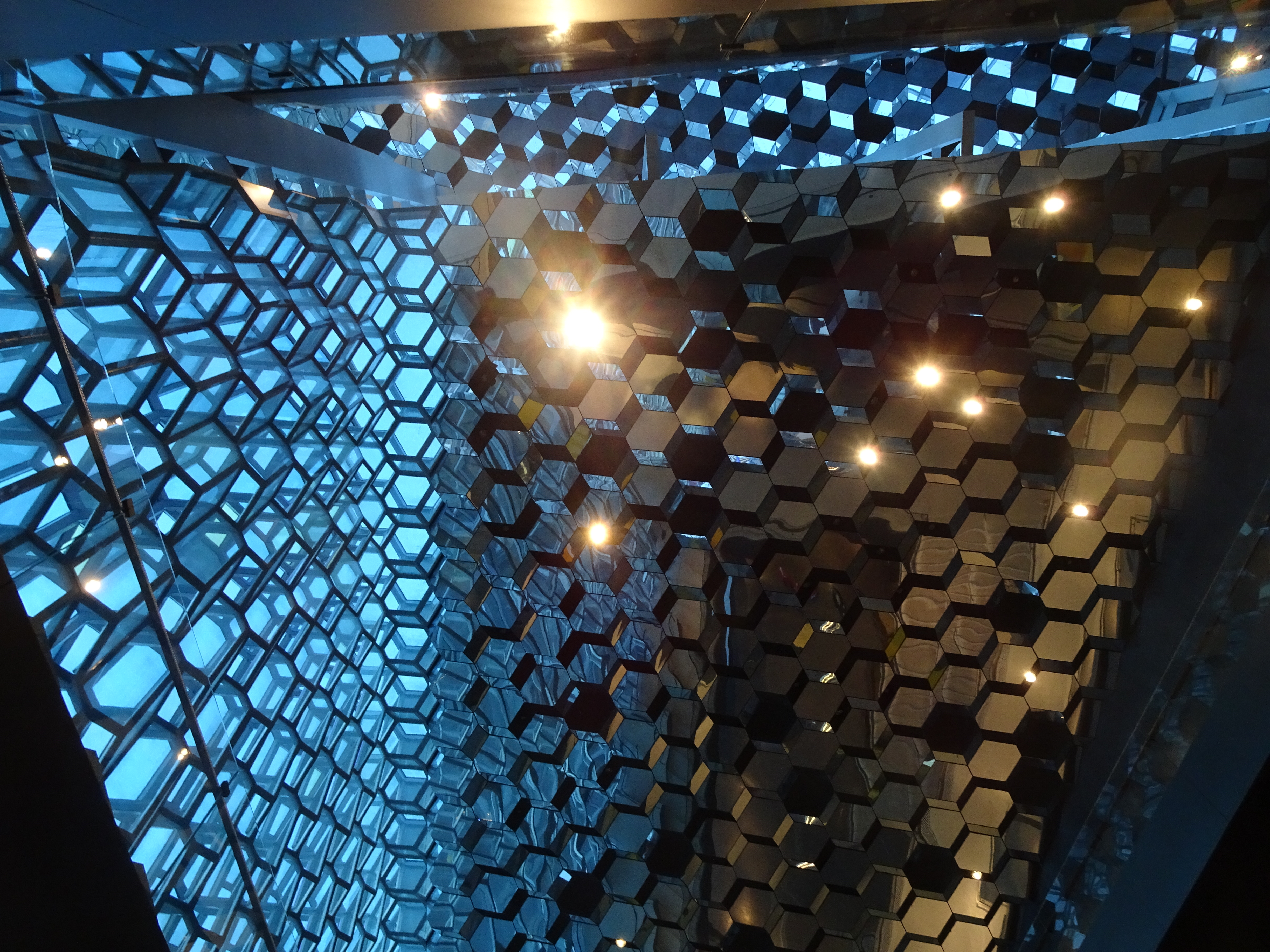


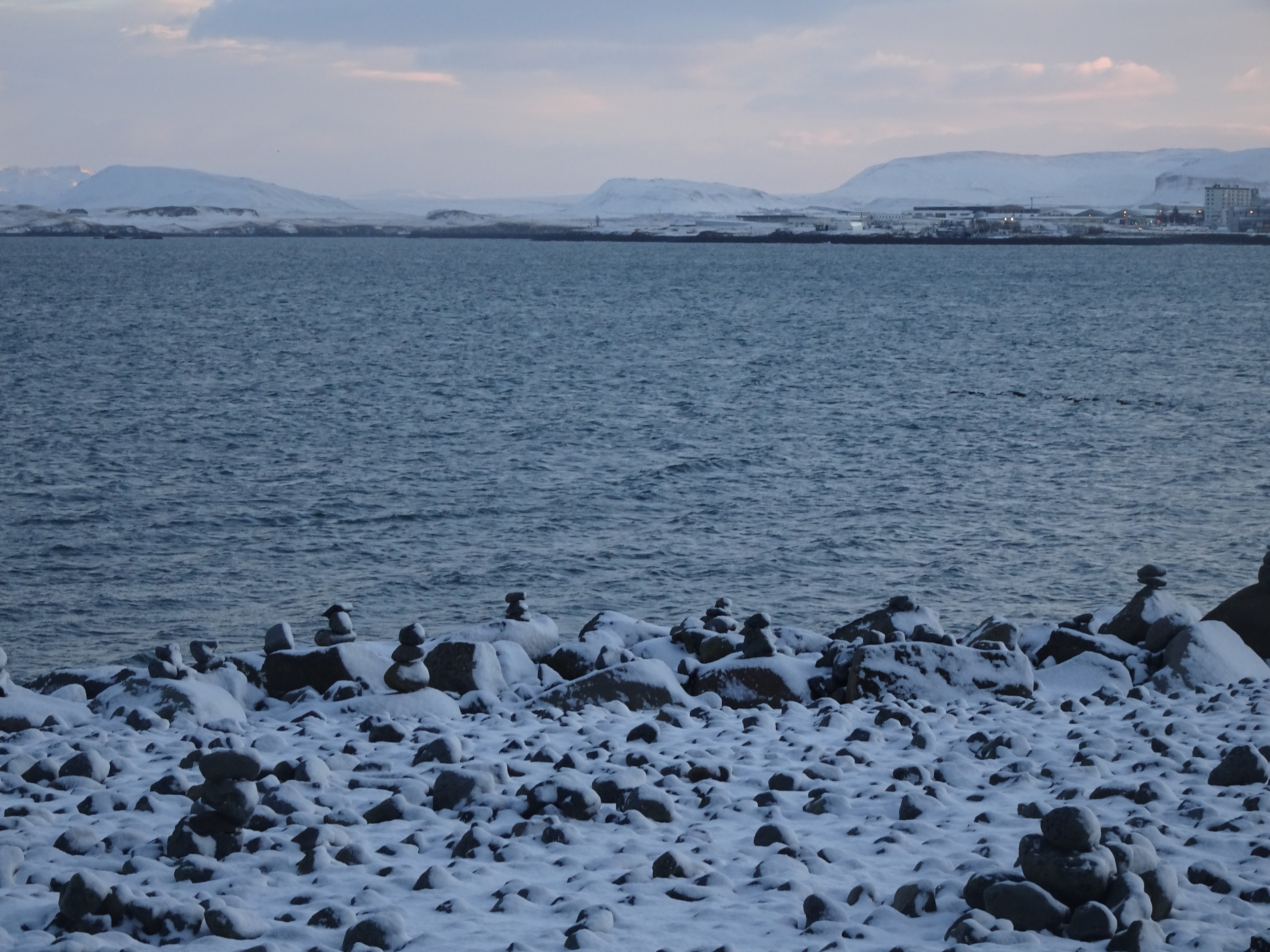
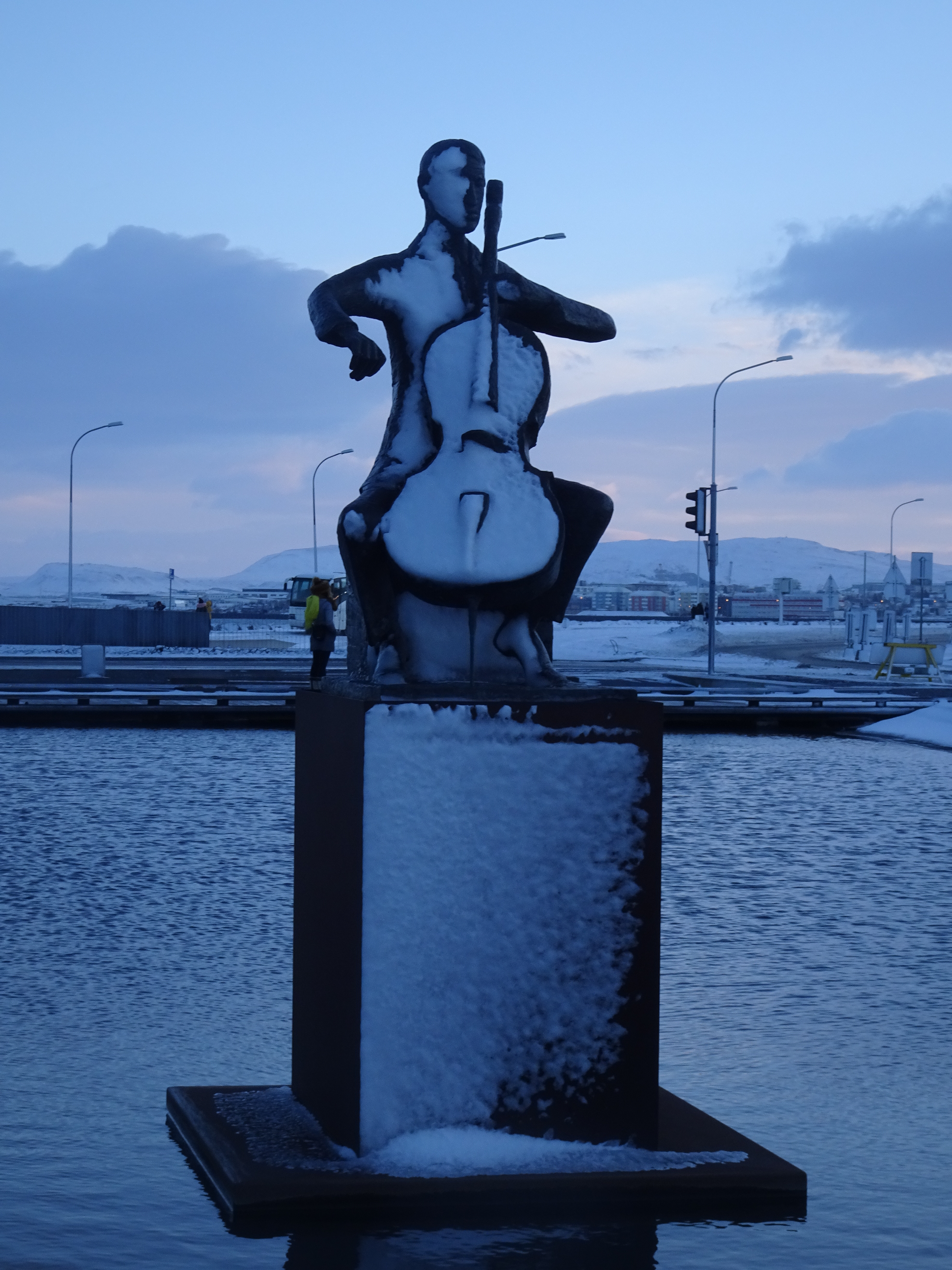

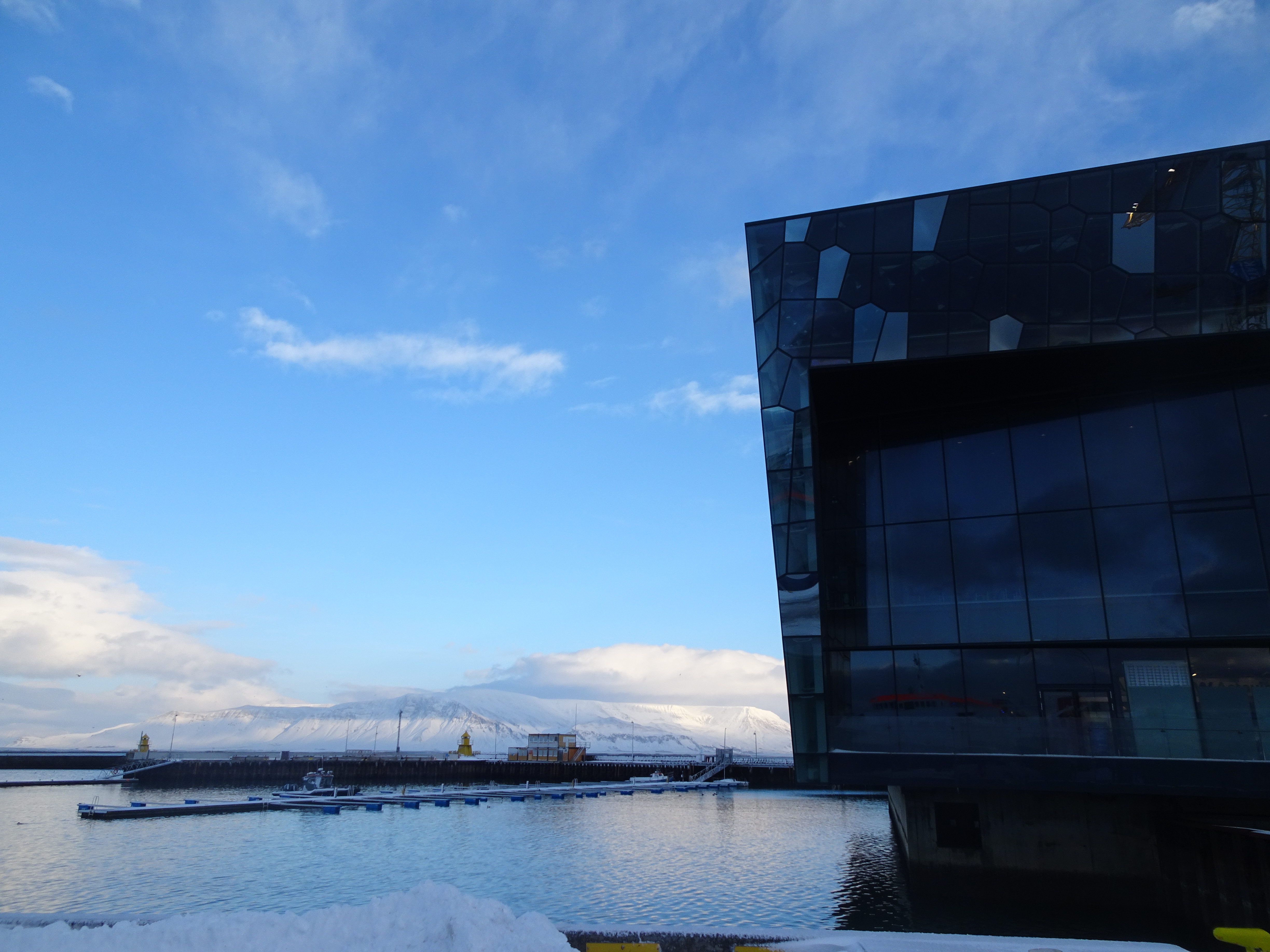

Next day in Reykjavík we had a good breakfast at the candlelit tables looking onto the snowy street and chatted to our fellow guests. It was very difficult to get used to it being dark until 11 am! We drove into the town centre along the stunning waterfront with the pink sky framing the mountains on the other side of the bay. We parked underground at the huge and architecturally impressive Harpa visitors’ centre on the water’s edge and set off to discover Reykjavík. It was only about -2C but it felt much colder as the strong wind was icy.


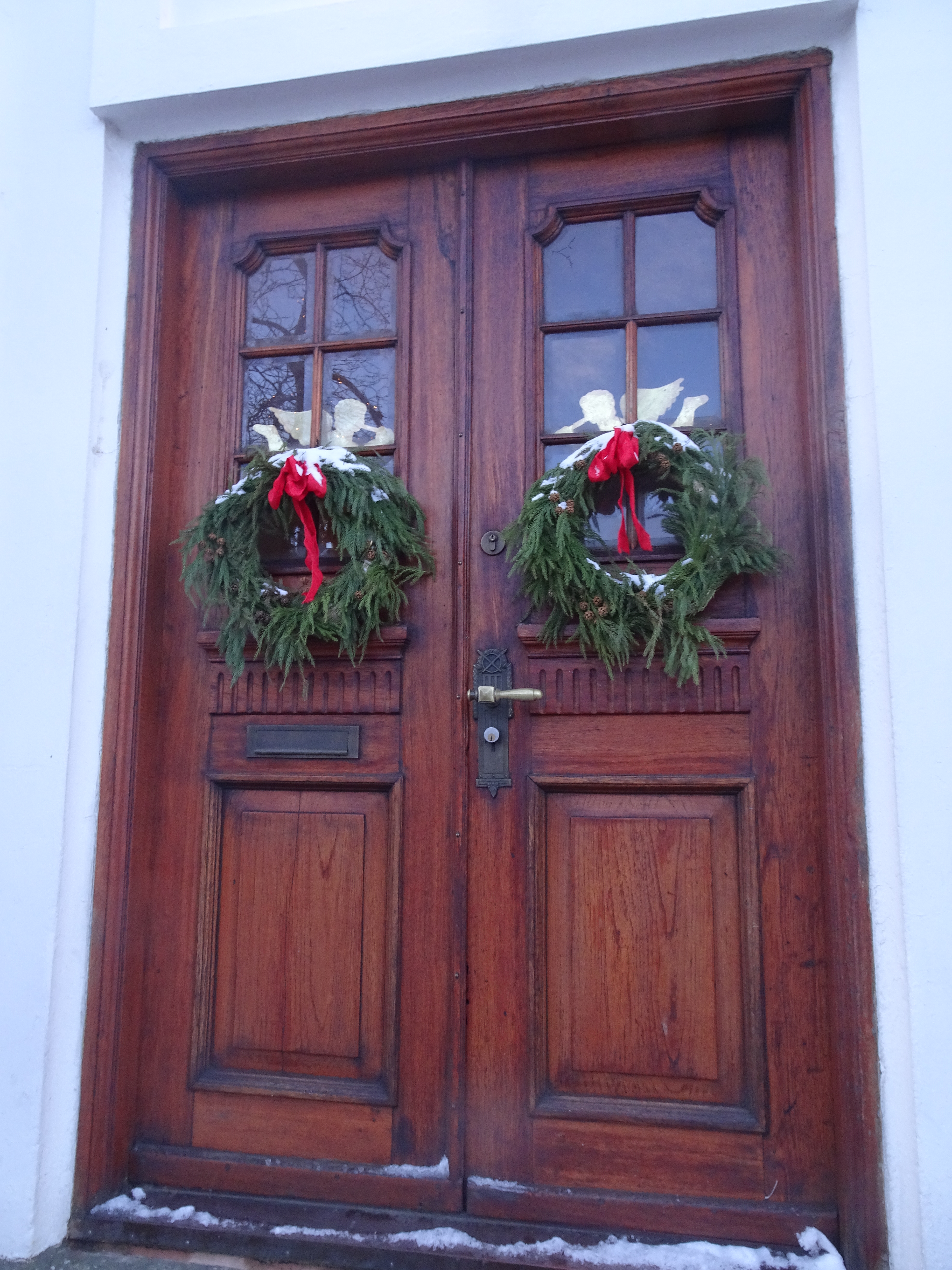


We walked through town and up the hill to the famous landmark Hallgrímskirkja Lutheran church at the top of the hill. The simplistic architectural lines of the interior are unlike any church I have seen anywhere – beautiful, streamlined and majestic and in stark contrast to all the extravagant opulence of all the Catholic churches and cathedrals I have been looking at all year.
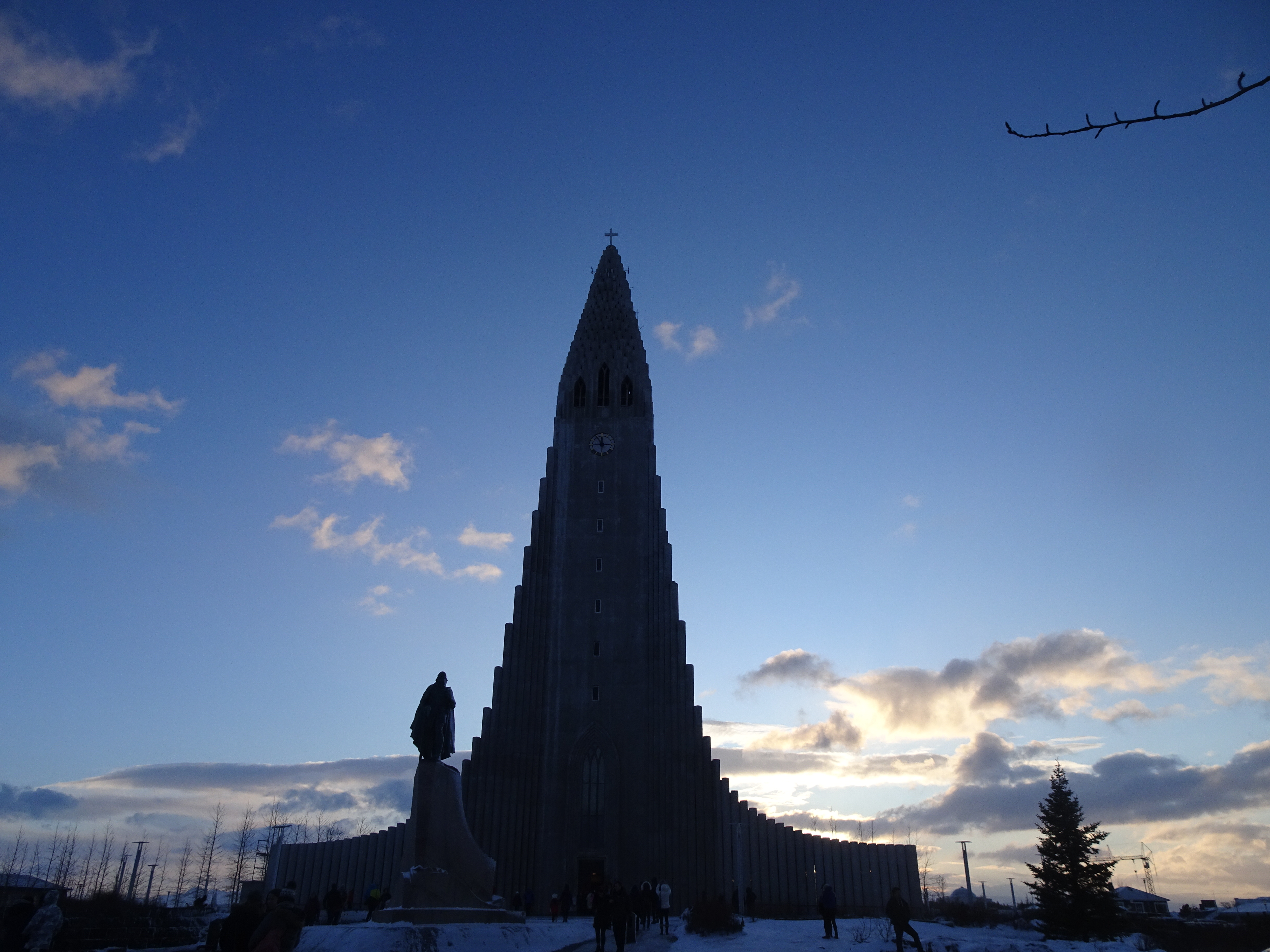


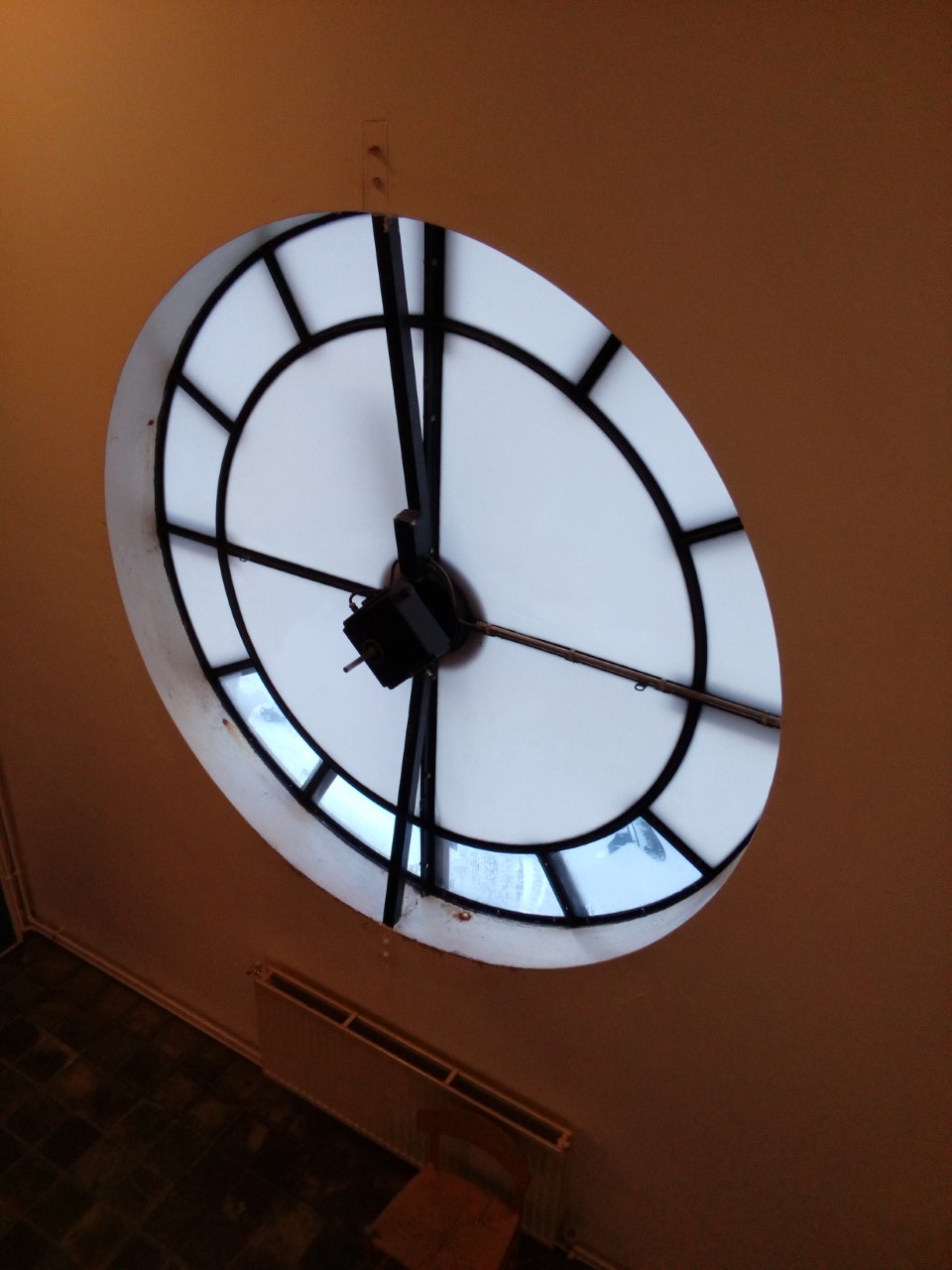
We bought tickets and joined the queue for the lift up to the top for stunning 360° views over Reykjavík from the top. No-one checks the tickets or the queue for the lift – you are expected to the do the right thing and buy a ticket and stand in line – everyone did.
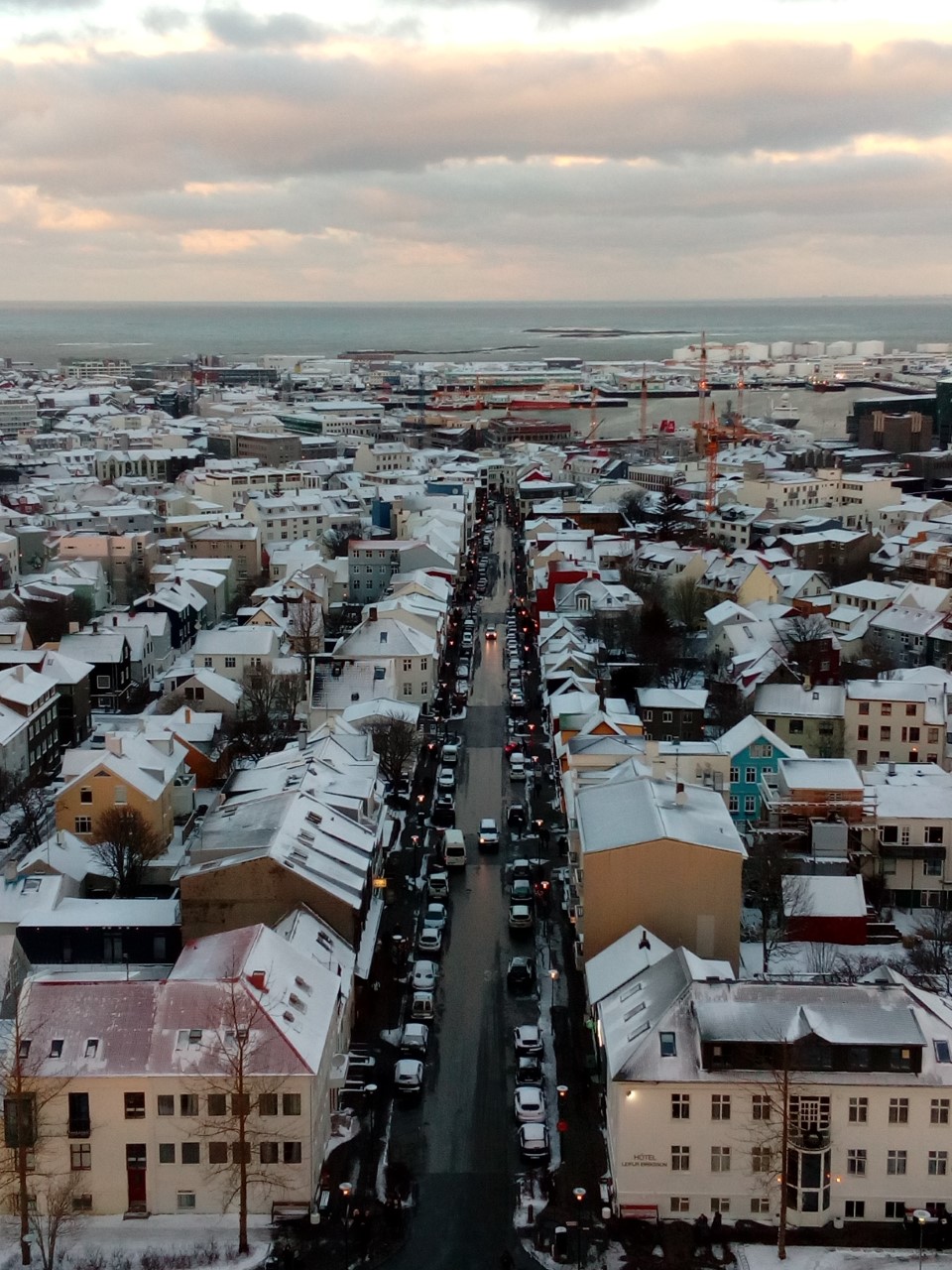

We stopped on the way back down for a delicious and warming traditional lamb soup and locally-made malt beer in the charming and characterful Babalú café (with the Star Wars themed loo!).
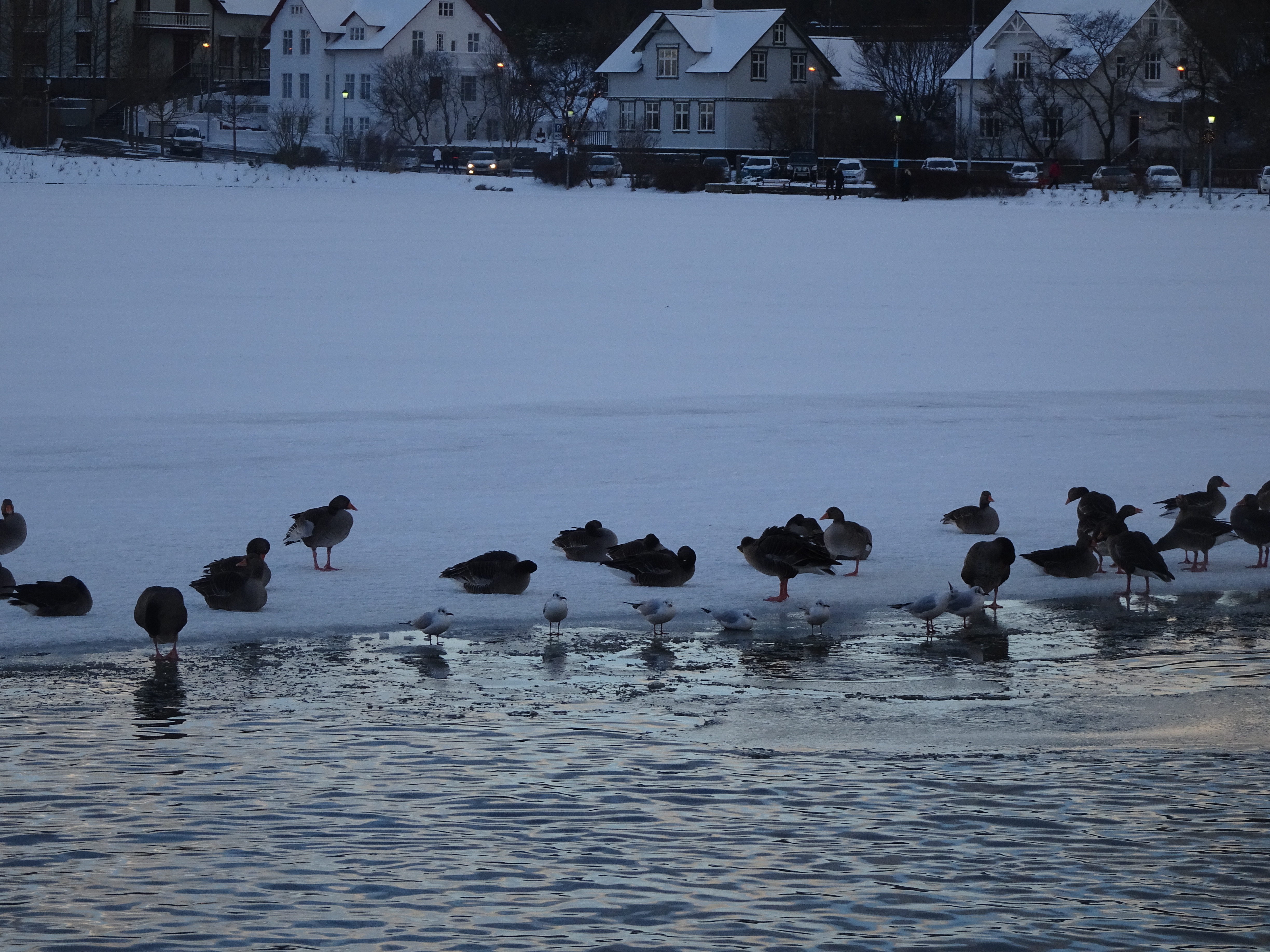
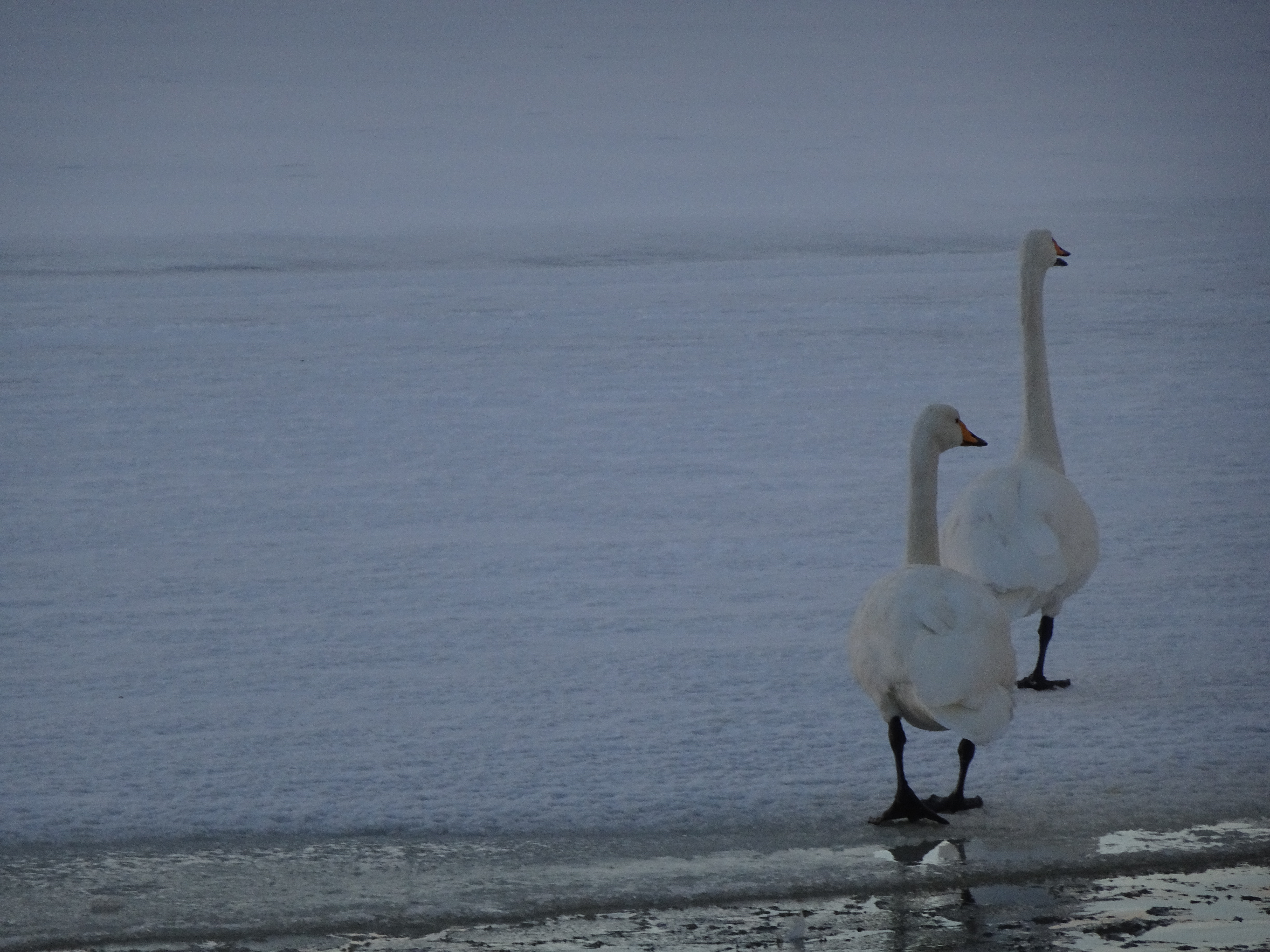
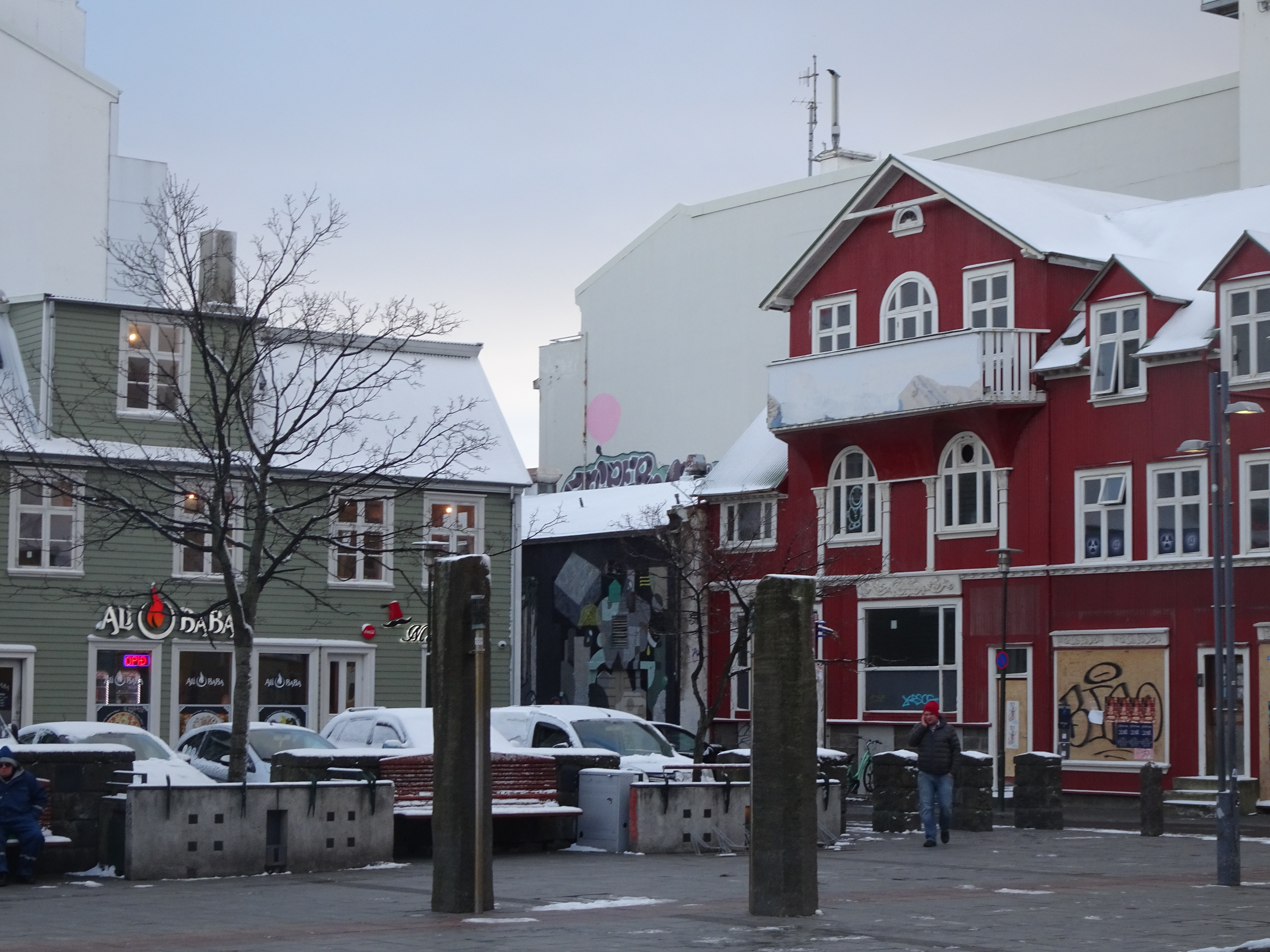
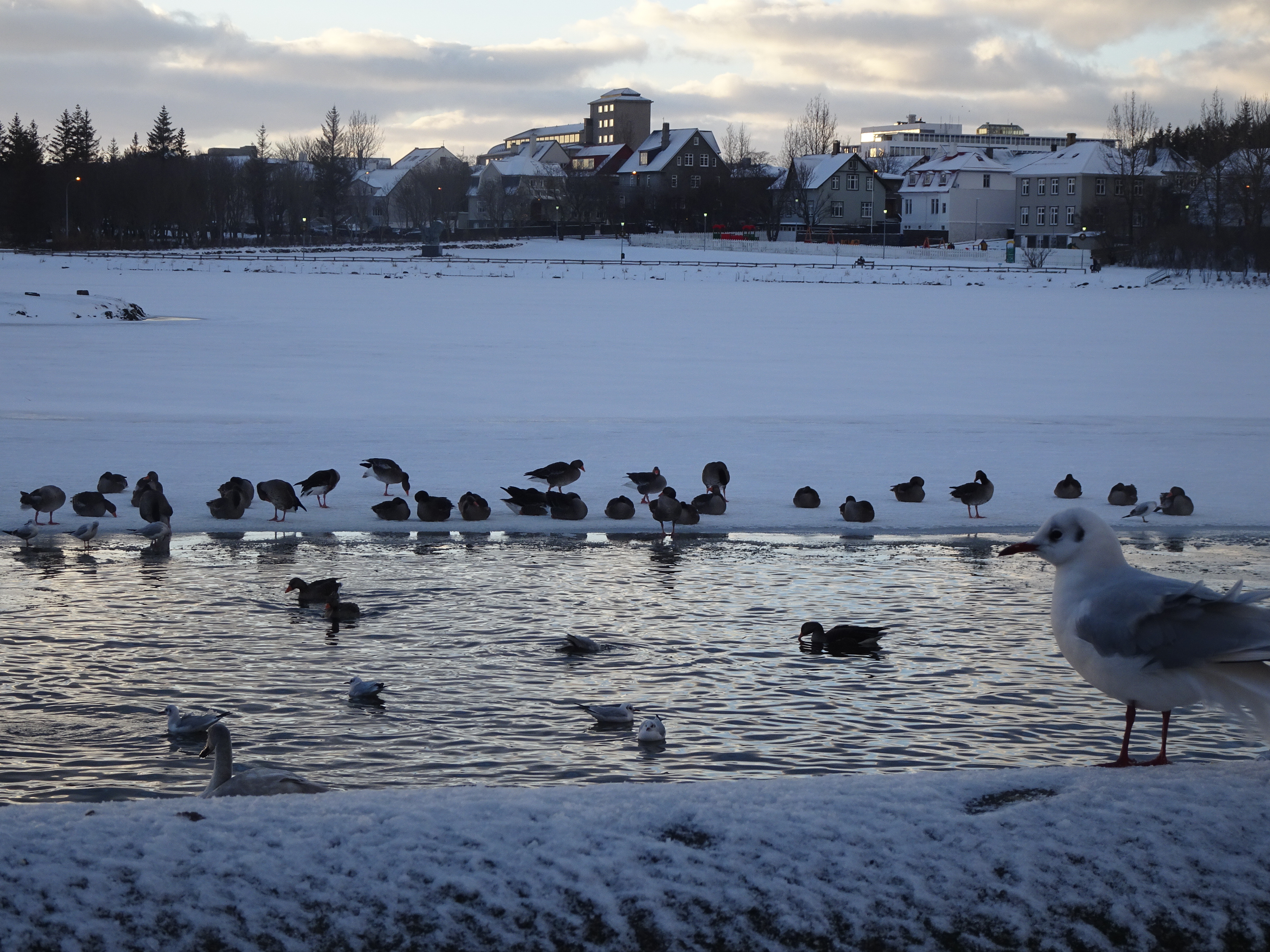
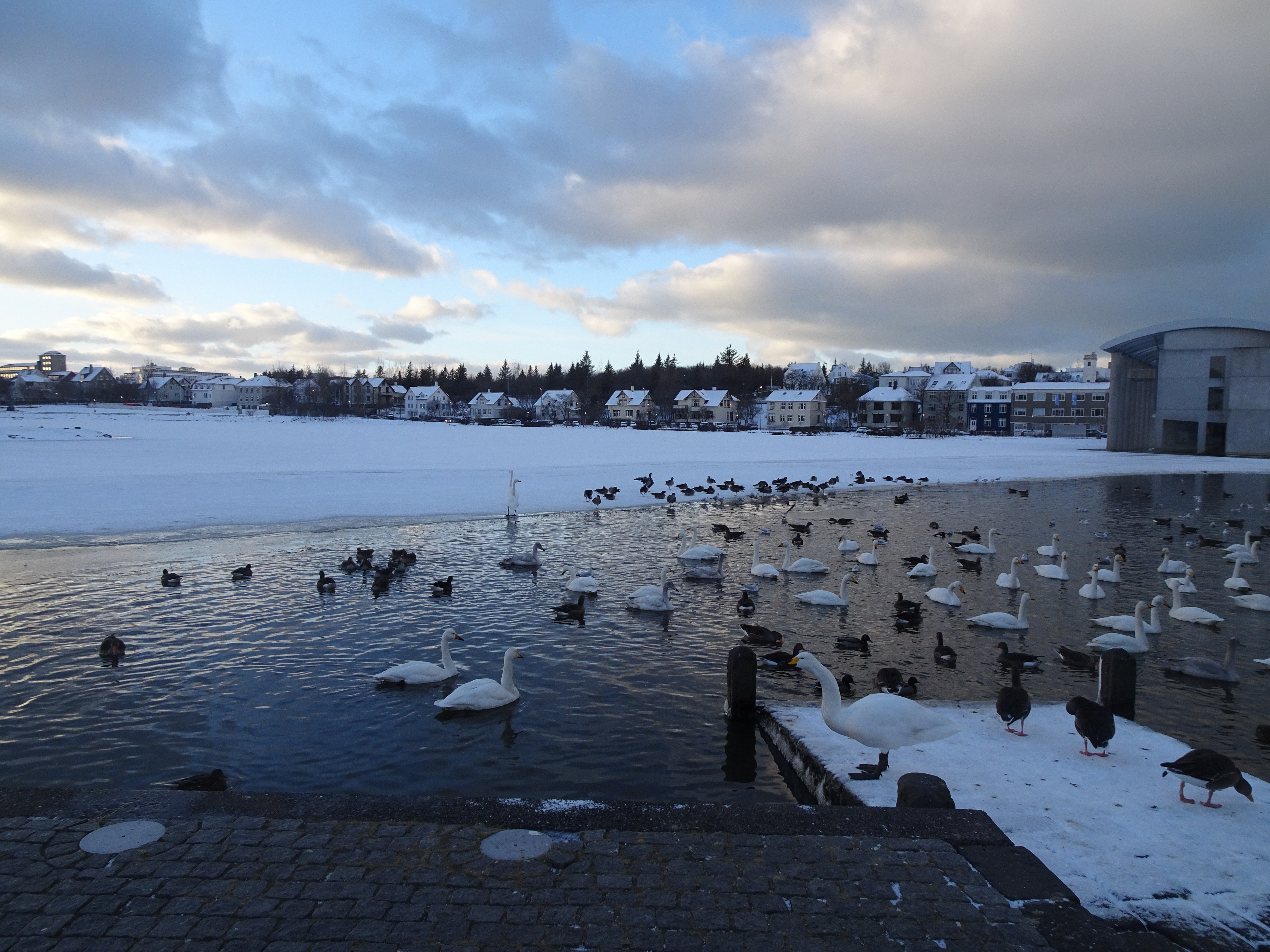
After we’d warmed up a bit, we explored the streets of the old town with the colourful, corrugated metal houses, restaurants and bars. The large snowy field turned out to be a frozen lake with lots of ducks and geese being fed by generous locals on the shoreline.



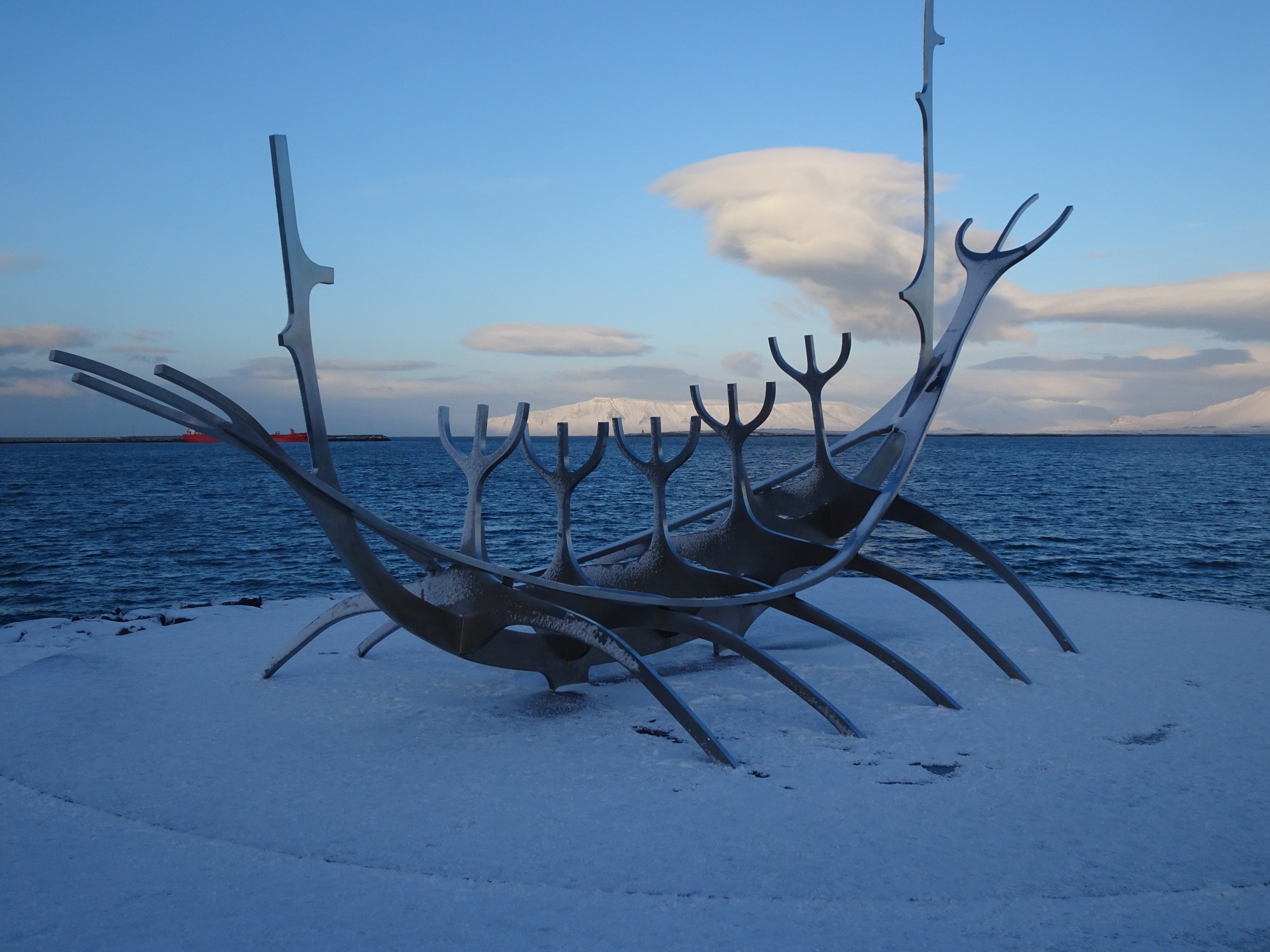
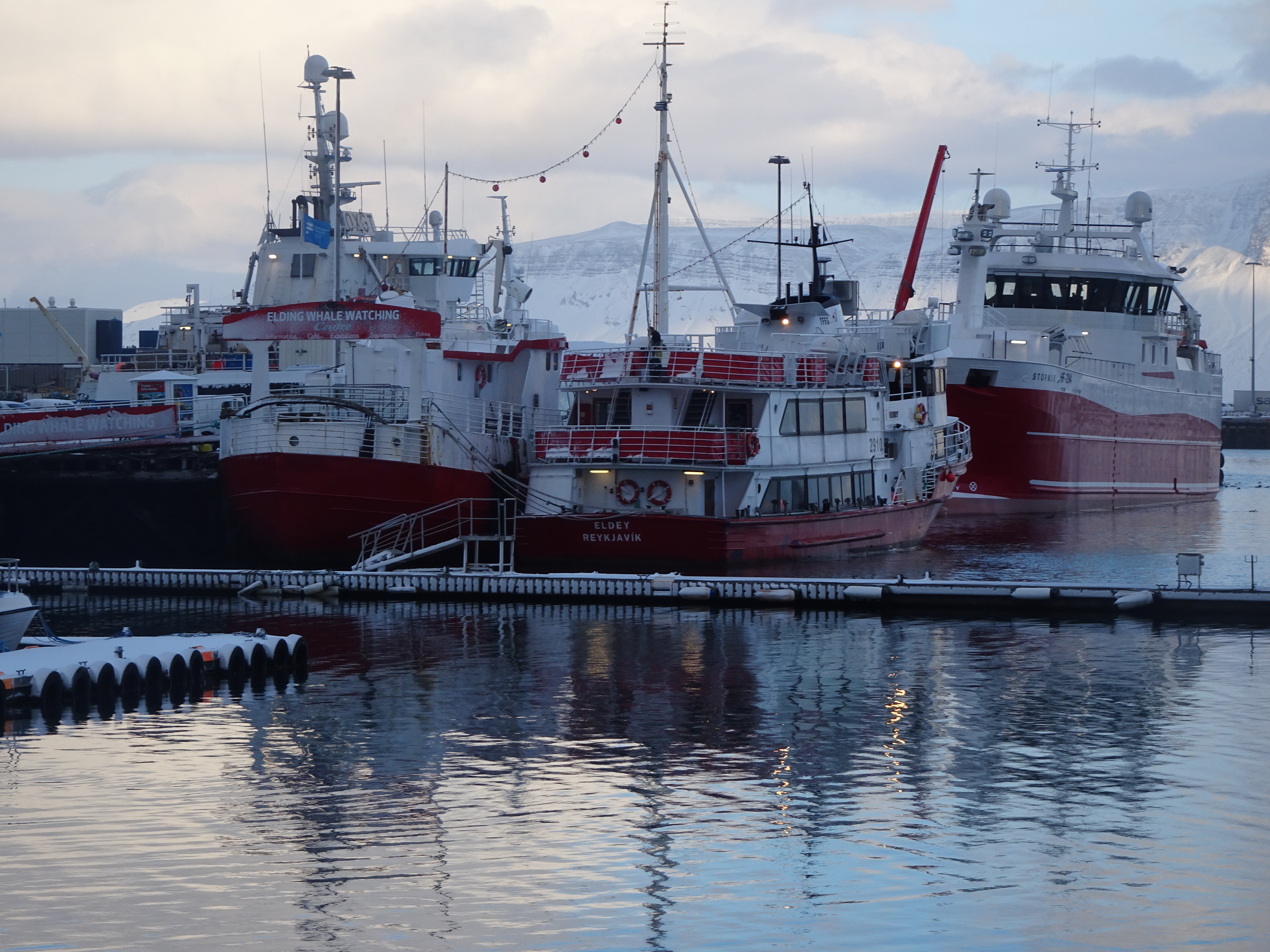
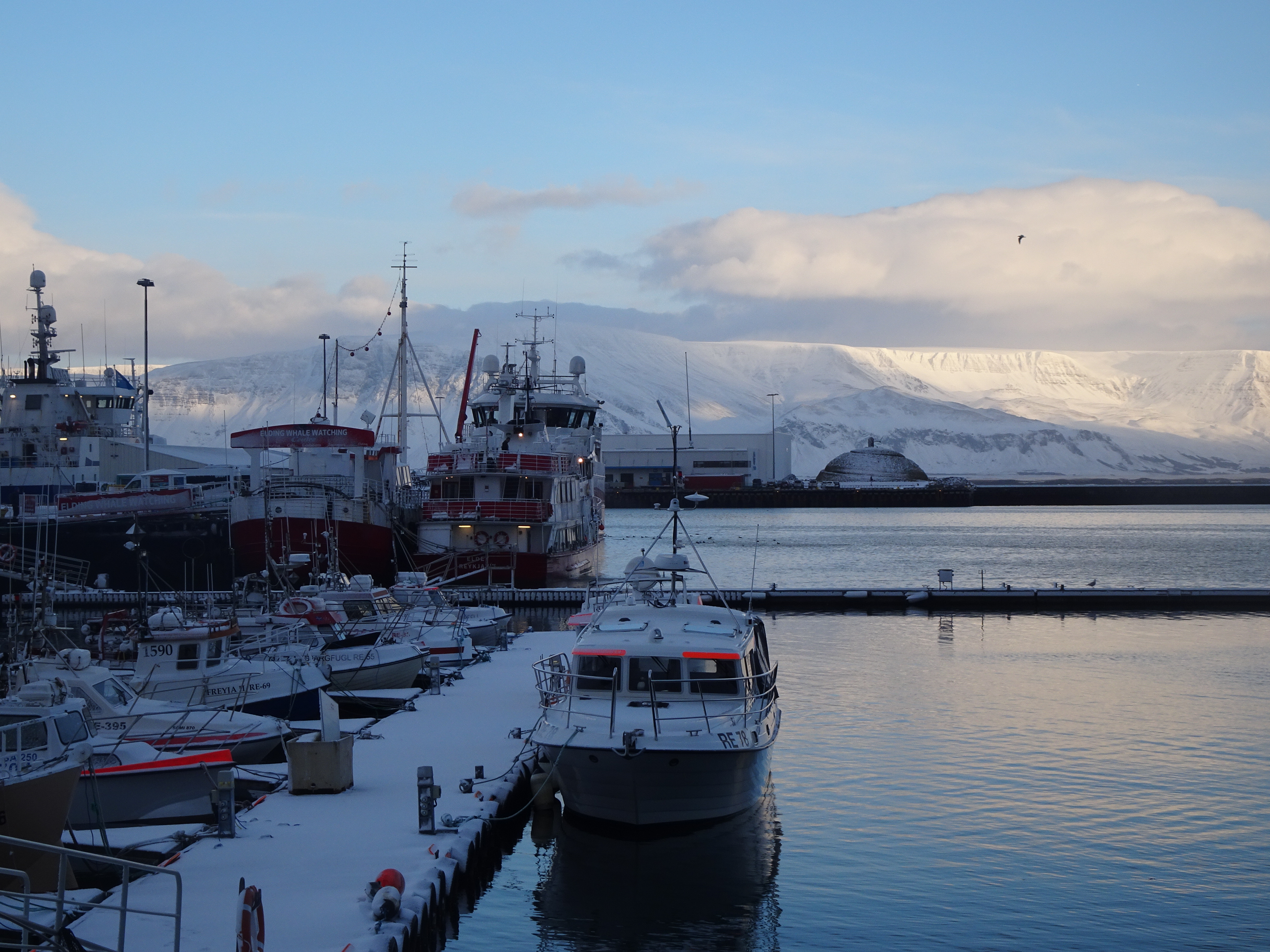
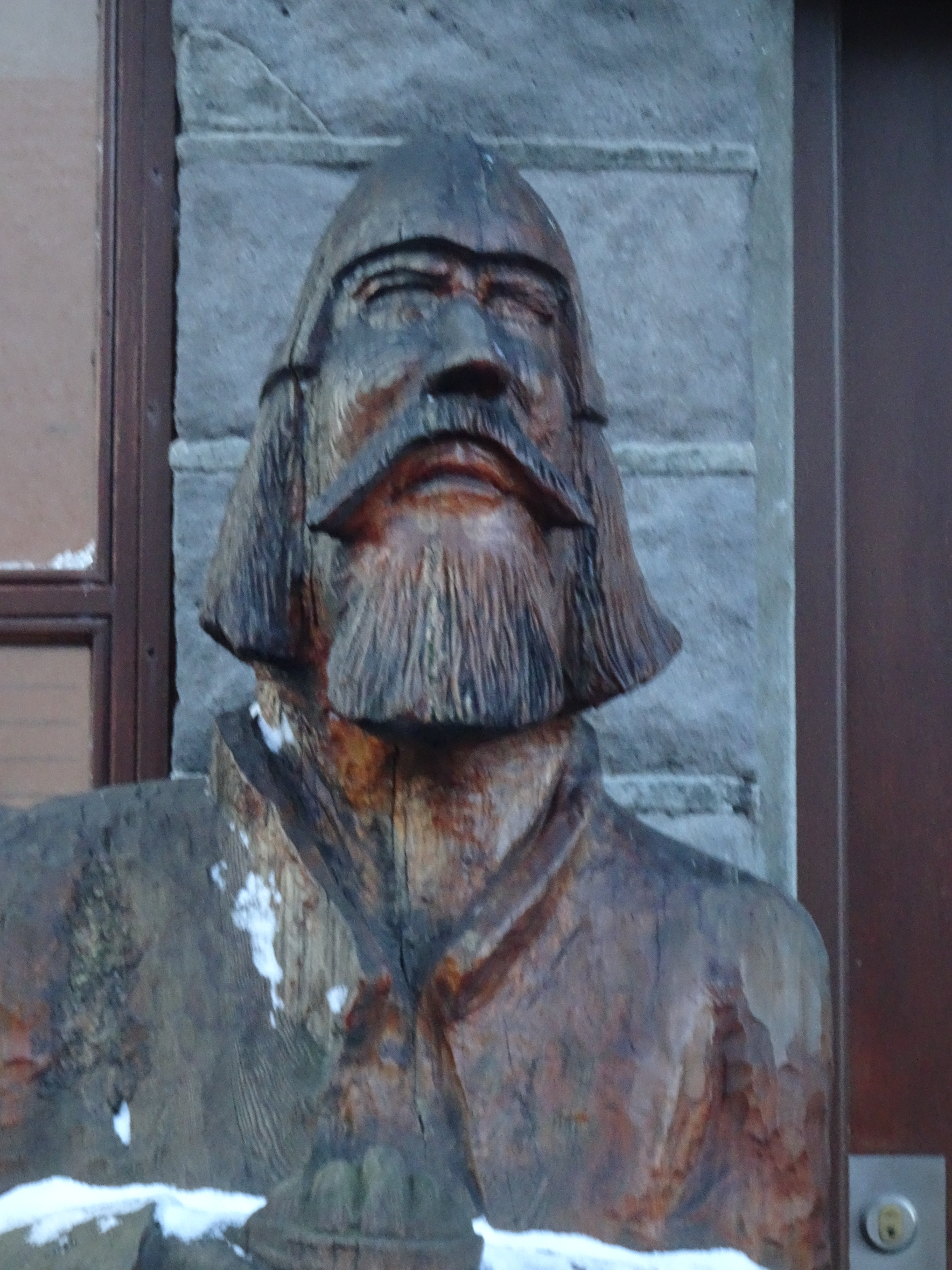
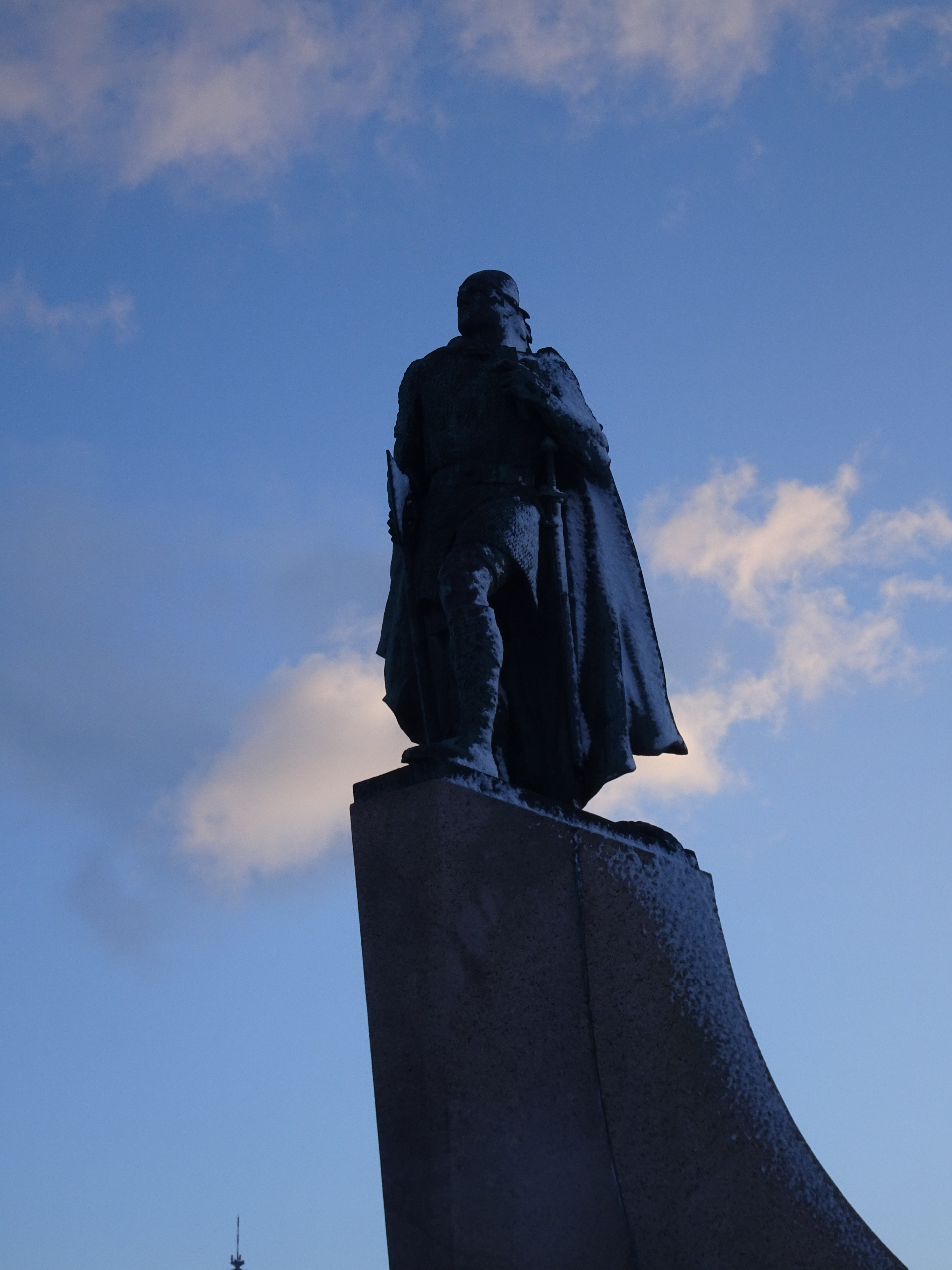
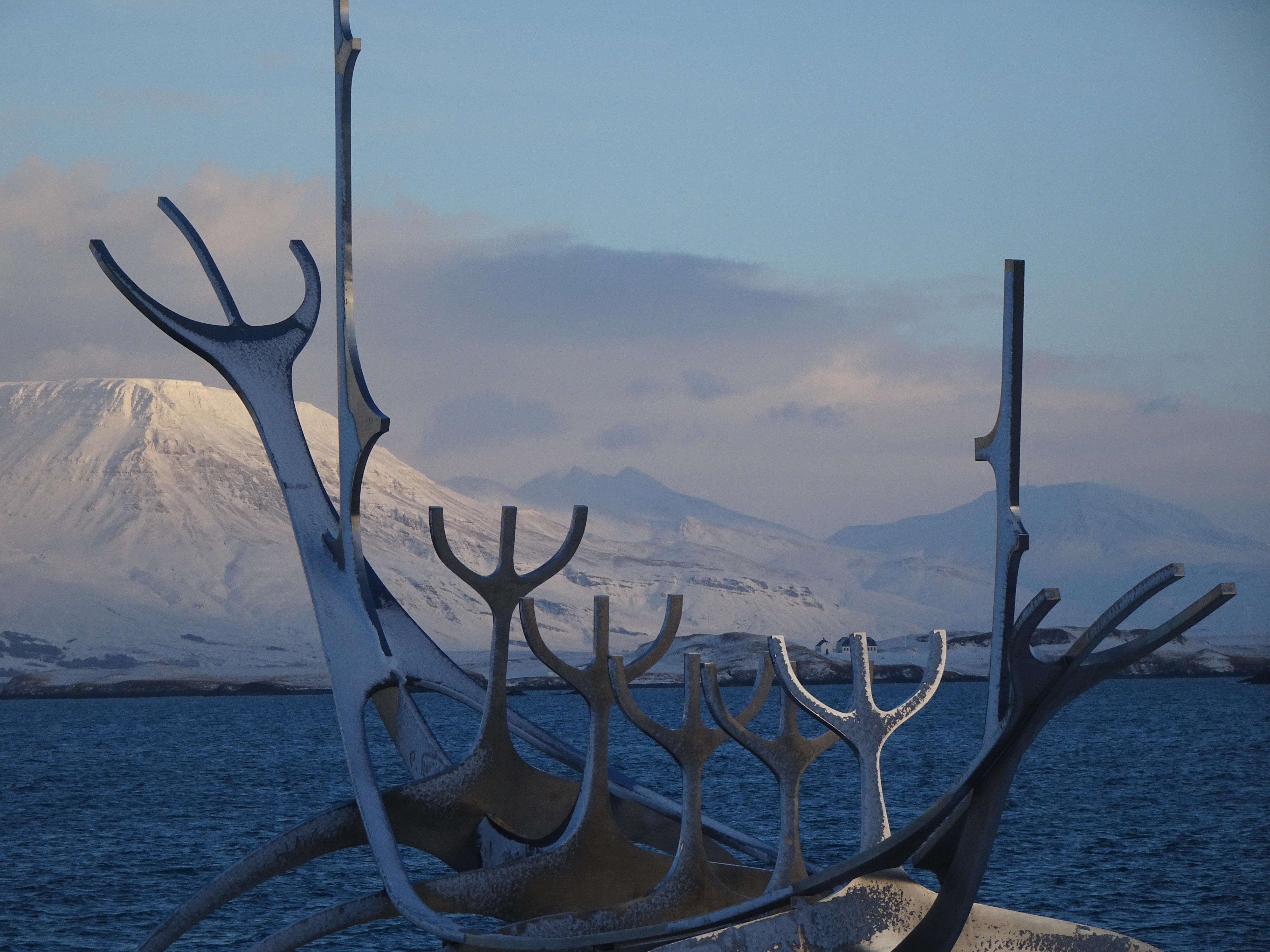
Down at the old harbour, the traditional fishing boats tied up to the pier with the mountains behind make a picturesque view for the customers of the bars and restaurants the old fishermen’s huts have been turned into. It would be lovely to come back and see Reykjavík in the summer. We reclaimed the car (once we managed to find it) and headed off. We spotted the Viking Monument at the water’s edge as we drove past it so made a very quick pit stop to take some pictures before we headed out of town and back to Keflavik and the airport.
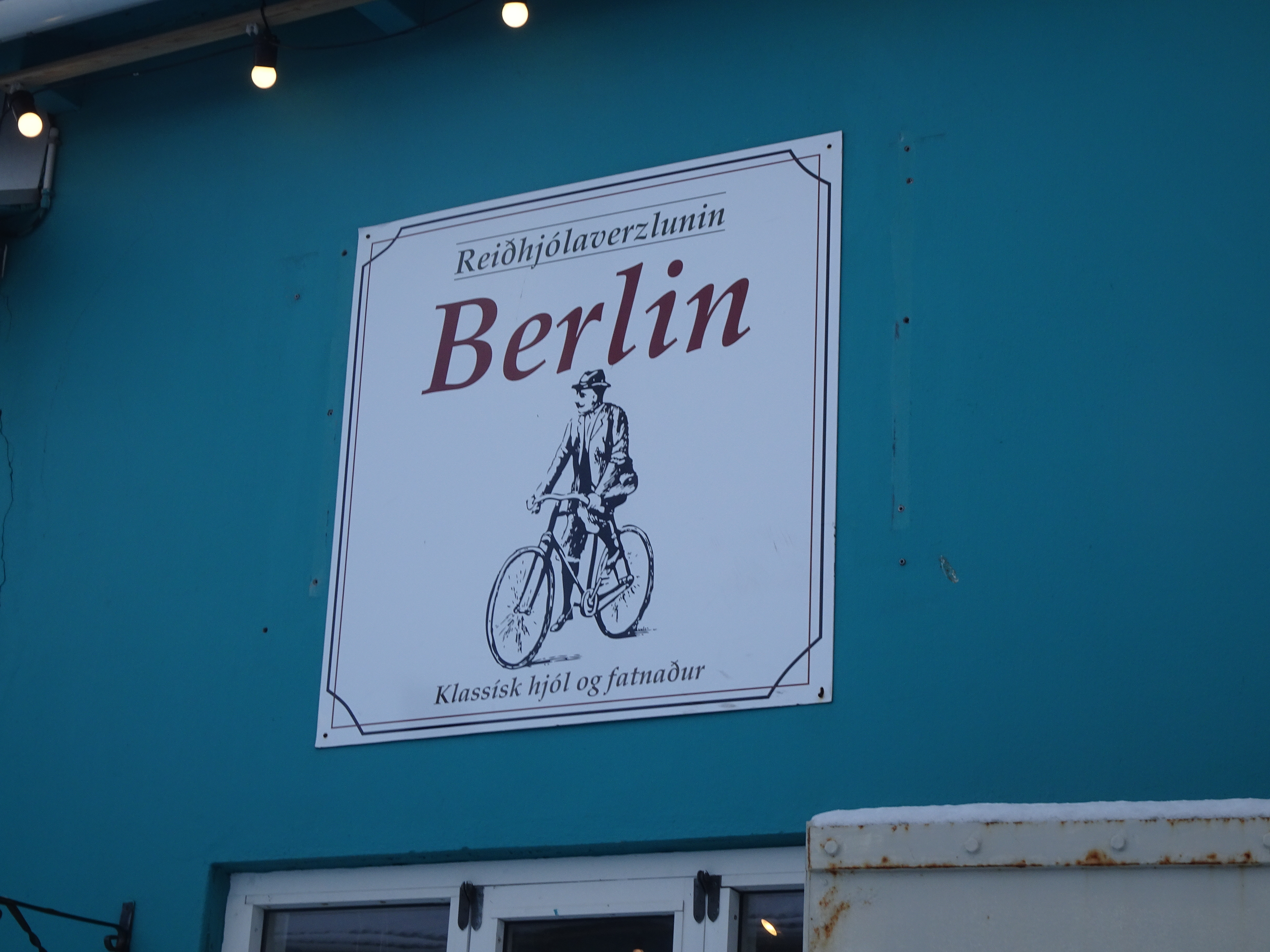
Icelandic is a fascinating language. For language geeks (such as myself) íslenska is an Indo-European language of the Insular Nordic branch of Germanic languages. Modern Icelandic bears a great similarity to Old Norse which means that modern Icelanders can easily read the ‘sagas’ which tell of the history of the island and its settlement as well as other classic Old Norse literary works written in the tenth to the thirteenth centuries.
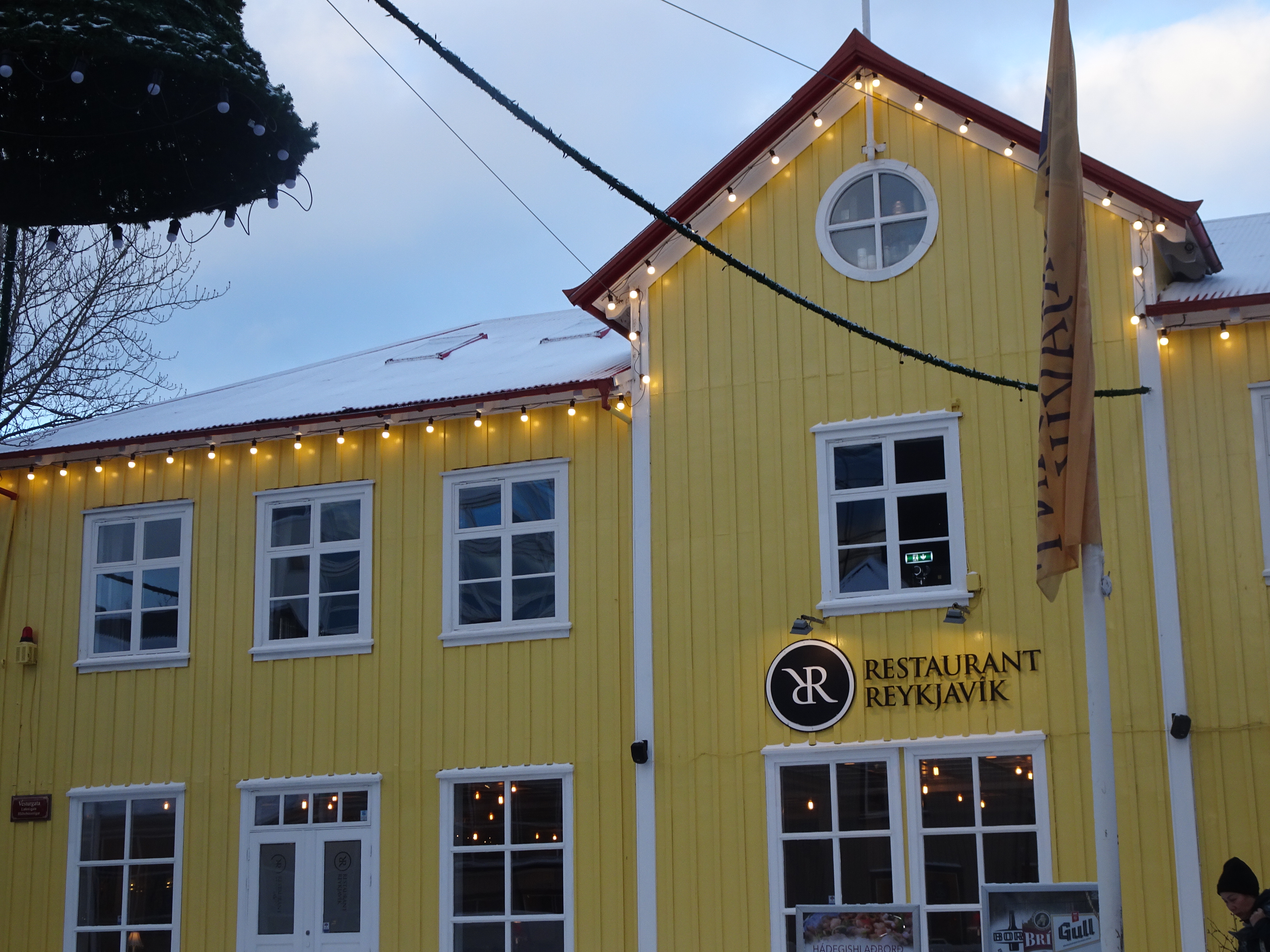

Icelandic is the official language of Iceland but islanders learn English and Danish (or another Scandinavian language) as part of their compulsory education. More than 8,000 Icelandic speakers live in Denmark, approximately 3,000 of whom are students. Icelandic is also spoken by about 5,000 people in the US and by more than 1,400 people in Canada, mainly in the province of Manitoba which was settled by Icelandic people back in the 1880s. The language is written in the Icelandic version of the Latin alphabet which has a few strange letters we do not recognise and have no idea how to pronounce! Since 1995, Iceland celebrates its language with Icelandic Language Day held on 16th November each year, the birthday of Jónas Hallgrímsson – a famous Iceland poet from the 19th century.
I am ashamed to say that this is the only place that I have visited in the whole of this project (and probably ever) where I didn’t learn a single word of the local language. I tried to learn at least ‘thank you’ but it was honestly so difficult to pronounce that I gave up (It’s ‘Þakka þér fyrir’ in case you’re interested!). The Icelandic people spoke perfect English and fortunately made it unnecessary. My apologies Iceland! I’ll try harder next time.
Iceland is a stunning, fascinating and impressive island. It produces 100% of its energy requirements from geothermal sources and has some fantastic organic principles around its food production and way of life in general. These are impressive people. Who has forgotten the Iceland football team’s famous Viking clap from the last World Cup? The huge influx of tourists in recent years, whilst contributing significantly to the economic success of the island, will undoubtedly have an enormous impact on Iceland’s environment. I hope they manage to contain it well. If anyone can, the Icelanders can. I’m so glad I’ve been to see Iceland now even if we didn’t see the Northern Lights! I would love to go again but in the summer next time so I could see more of the island without the snow.


Iceland was a brilliant final island! My thanks to Deb, my great friend, co-driver and travelling companion (who will be bringing her whole family back to Iceland soon) for accompanying me and to Iceland for being a fabulous final island number 53! Definitely go to Iceland – hire a car, drive around as much as you can, wallow in as many different sorts of hot water possible, eat the soup, try the gin, do happy hour with the locals and – if you’re really lucky – see the Northern Lights!
NEXT (AND LAST) POST: My favourite island(s)
 53 islands!
What a wonderful choice to conclude your project ! I would be very unlikely to go there, despite the information and enthusiasm conveyed by your report. Many sincere congratulations for an amazing journey through so many islands! Such a truly riveting and informative peregrination, Many, many Thanks for being our guide,now I will start again at Aeolian!
LikeLiked by 1 person
Thank you Spraitley for being 53 islands most dedicated follower! Lots of love xxx
LikeLike